Showing posts with label Village. Show all posts

Monday, 5 December 2011

My Village, My Home, My Life - part eleven

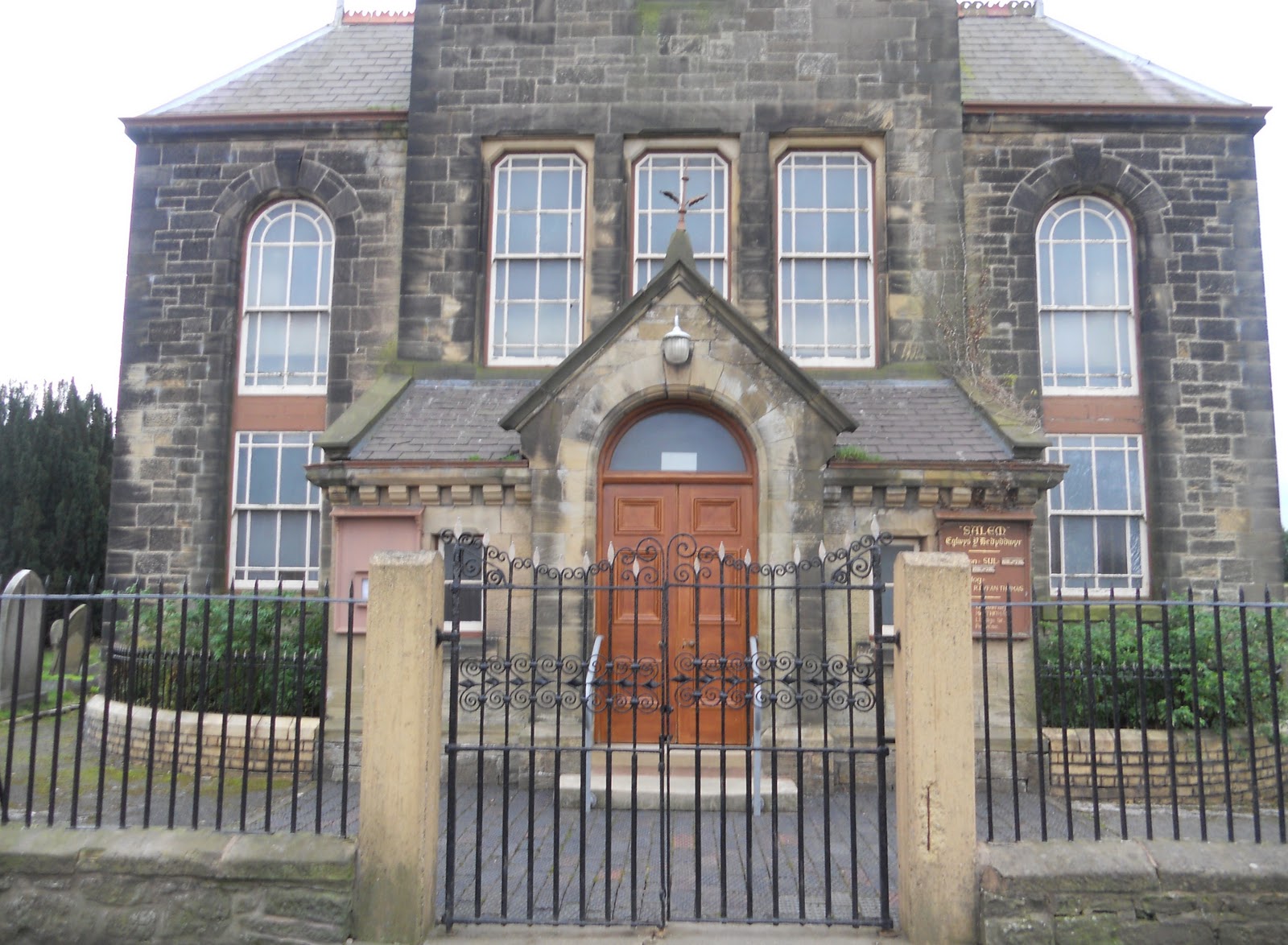
Chapel House, Tainant
Last week was a great week for family and local history. I left the village of Penycae over 43 years ago, and it's taken me all this time to get an interest in my roots. I think that I'm making up for that, as there's hardly a day goes by without me researching my family, or researching my local area. I'm loving every minute of it, though with over 1000 names now in the family tree, I still haven't come across anyone that has made a big impact on the global scene.

The family over the last 150 years or so have been good, honest, down to earth coal miners, and my admiration grows daily for both husbands and wives as they battled with dangerous jobs, poor money and bringing up large families in two roomed cottages.

My Grandmother's side (Mum's Mother), is the Valentine family, and for at least three generations they came from the tiny hamlet (is that tautology, as is there any other type of hamlet?) of Tainant, which is about one mile outside of the Penycae village. Let me bore you a bit more with some stats about Tainant. According to the website Mouseprice.com, and the Land Registry, there are currently 23 properties in the hamlet, with the oldest being just under 200 years old. The main family home is no longer there, but one or two other properties lived in are still occupied. The most expensive house purchase is Chapel House, which is the converted old Methodist Chapel, and in 2005 sold for £333,000. The least expensive sold for £17,500 in 2000. I tried to take a picture of Tainant when I was up there last week, but because of its topography - winding valley with heavy tree growth on either side - it wasn't possible to see more than one house at a time, no matter where I stood. It has been fascinating piecing together the very large Valentine family that has its roots in Tainant.

Another thing that I did last week was to join the Clwyd Family History Society. Their office and Resource Centre are only a few miles from Penycae, and they focus on the history of North East Wales.  Clwyd no longer exists except as a 'Preserved County', which is largely ceremonial. The area it covered ceased in 1996 and became Conwy, Denbighshire, Flintshire and Wrexham. Regional reorganisation has often amused me, as in 1974 Clwyd was established from a merger of Flintshire, most of Denbighshire and part of Merionethshire. The wheel has largely turned full circle in less than twenty years. The Society is run by volunteers, and produces excellent material for those interested in the family history of that area. One booklet that I came across was the burial register of Salem Baptist Chapel in Penycae, which has been extremely helpful in filling in some gaps in my family tree.

1st Salem Chapel 1806
During my visit to the village last week, I met up with the person who looks after the burial register, who helped me to find my way around the graveyard. During that time, and having coffee with him and his wife at their home afterwards, I learnt much that I was unaware of.

Previously, I'd been researching where Penycae Particular Baptist Chapel was situated, and low and behold this is what Salem had been called in the past. The present Salem Chapel was built in 1878, and while I was vaguely aware that there had been another one before that, I did not know that there had actually been three Salem Chapels.

The picture opposite is of the first Chapel, which was opened in 1906. "T Capel Cyntaf" means the first Chapel. Two cottages at the top of Bridge Street were converted into the Chapel. This is opposite the small graveyard which was used by that Chapel. Unfortunately, all burial records from that time were lost a long time ago. The plaque which you can just see between the upper floor windows is in the present Chapel. This Chapel lasted for about twenty years, before there was the need to provide a bigger, purpose built building.

2nd Salem Chapel 1825
In 1825 the newly built second Chapel was opened. It stood on the corner of Bridge Street, Chapel Street and Church Street, just a few yards from the first building.

It stands directly opposite the present Salem Chapel, and those who know the graveyard can see from the way that they are facing, which direction the Chapel was in.

Though there is a burial register, it is not easy to find graves in what they call this middle graveyard, particularly those that are unmarked, and there are plenty of those. After a while, it became difficult to work out where one line of graves ended, and another started. Mind you, it was damned cold and windy when I was there, so the thought processes were probably weakening.

3rd Salem Chapel 1878
And so, just over fifty years later, the current Chapel was opened in 1878. I think it's a lovely stone building with a graveyard on either side of it. So far, I've found 14 relatives graves at Salem, but as there are another 17 graves with Valentine's in them, there may be more relatives to come.

It was decorated inside about five or six years ago and looks beautiful. It has a balcony at one end (that's the top windows in this photograph), and behind the pulpit at the other end is a magnificent early 20th Century pipe organ. Though Church music, along with all other forms has moved on a bit over the years, I still think it's hard to beat a quality pipe organ, played by a quality musician.

I learnt two things from my new friend at the Chapel. The first was that my Father drove a lorry for a man who ran a local haulage firm in the late 1940's. This filled in a gap that had been annoying me. There was a two or three year gap between when my parents moved to the village, and when he started working for the local electricity company. What had he been doing in that time? While I'm still trying to get official confirmation of this, it looks like he was driving a lorry.

The second thing I learnt was concerning a brother who died before I was born. I think that the first thing I knew about him was when my Father had been buried, and I was eleven. For over 50 years I've been trying to find out information about him; where were they living at the time? And what did it mean when the grave says that he "died in infancy"? My Mum would never speak of it; perhaps it was all too painful. However, last week I found out that the address given was the Wern, which would have been my parent's first married home - this also helped to give me a more accurate time line of when they moved to Penycae. The burial register also said that my Brother died at 11 hours old. In researching the family tree, I've noticed how many children died very young, but 11 hours must have been particularly distressing.

All communities have their stories to tell, but isn't there something special in stories about your village, your home or your life? As soon as I think that I've come to the end, somehow something else crops up, so who knows what the future will bring.

Wednesday, 23 November 2011

My Village, My Home, My Life - part ten

Penycae Reservoir, Keeper's House
I spent the first 21 years of my life in Penycae, and I've written quite a bit about the village. However, over the last few months I've been putting our family tree together, and I came to realise how little I knew about the history of the area.

Before Penycae became an ecclesiastical parish in its own right in the late 1800's, it was part of the ancient parish of Ruabon. In "A Topographical Dictionary of Wales, 1833 & 1849" by Samuel Lewis, he describes Ruabon as "a parish in the Union of Wrexham, containing in 1841, 11,292 inhabitants. The parish is situated in a picturesque part of the county, within three miles of the great Holyhead road, and is bounded on the south by the river Dee. The village seems to have been indebted for its original prosperity to the noble mansion of Wynnstay, in the immediate vicinity, and to owe its present importance chiefly to the mines of ironstone and coal which abound. The parish comprises an important part of the Denbighshire coal tract, of which the principle seam is here nine feet thick; and its mineral wealth in coal and iron ore, which has caused the establishment of numerous works. The whole give employment to from 1400 to 1500 men and boys. Offa's Dyke and Wat's Dyke both intersect the parish, and in their courses approach within a quarter mile of each other, near the village".

Wynnstay Arms, Ruabon
People have lived in Ruabon for over 3,000 years, and this ancient parish comprised the townships of Belan, Cristionydd Cynrig (or Y Dref Fawr), Coed Cristionydd, Cristionydd Fechan (or Y Dref Fechan or Dynhinlle Uchaf), Dinhinlle Isaf, Hafod (or Hafod y Gallor), Moreton Anglicorum (or Moreton Above), Moreton Wallichorum (or Moreton Below), Rhuddallt and Tref Robert Llwyd. The names Above and Below refer to their proximity to Offa's Dyke. ie, above it or below it.

Local history did not form part of my school curriculum, so most of the above names were unfamiliar to me. Of course, I knew about Offa's Dyke, but I wasn't aware how extensive the name Cristionydd was. In Penycae, I was born into the part of the village called Pentre Cristionydd, and until I left the village, I lived in a council house on a street called Cristionydd. By the middle of the 19th Century things were beginning to change, with new ecclesiastical parishes being formed, resulting in Ruabon parish becoming much smaller.

On the 24th May 1844, Coed Cristionydd and part of Cristionydd Cynrig went to the new parish of Rhosymedre. On the 3rd September 1844, Cristionydd Fechan went to the new parish of Rhosllanerchrugog. On the 28th October 1879, Moreton Above and the remainder of Cristionydd Cynrig went to the new parish of Penycae. So that's when my village became part of the newly formed ecclesiastical parish of Penycae; 28th October 1879.

St Thomas' Parish Church, Penycae
In anticipation of the new parish being formed, the parish church of St Thomas' was consecrated in 1878. However, at this time, most of the population of the parish were non-conformists, and attended their own Chapels.

These were, Salem Welsh Baptist Chapel; Groes (Sion) English Baptist Chapel; Groes Welsh Calvinistic Methodist Chapel; Tainant Welsh Calvinistic Methodist Chapel; Soar Welsh Wesleyan Methodist Chapel, and Copperas English Primitive Methodist Chapel. Baptists and Methodists obviously abounded in my village. In "The Statistics of the Nonconformist Churches for 1905", the aggregate number of adherents for the two Baptist Churches was 449, and for the four Methodist Churches it was 577. Half of these Churches are no longer open, and those that are, do not have anything remotely like the numbers of 100 years ago. It should be said in balance that the 1905 figures were probably inflated by the Welsh Religious revival of 1904.

Groes Welsh Calvinistic Chapel, Penycae
Perhaps a word about non-conformity would not be out of place here. The Welsh have always been of an independent spirit, and have not liked been told what to do by London; be that Parliament or the King. There was also a strongly held view that every man had the right to worship God as he saw fit. An Act was passed in 1662 that required everyone to conform to the Church of England. Those who didn't were called non-conformists. Quakers, Baptists and Independents (later to be called Presbyterians) were the first Welsh non-conformist groups.

Following years of persecution, which began to ease by the middle of the 1700's, non-conformity increased steadily. Researchers say that by 1851, about 75% of the Welsh population belonged to a non-conformist group. Part of the persecution was seen in the act of marriage. Between 1754 and 1837, non-conformists could not legally marry outside the Church of England - except for Quakers and Jews. This exception is for another story. Non-conformity is still very strong in Wales, and it's little wonder, as they had to fight so hard to get their religious freedom. Salem Baptist and Groes Methodist are the only non-conformist Chapels in the village with their own graveyards; adherents of other groups tended to be buried in the parish Church cemetery.

Council Offices Wrexham
Local Government reorganisation in Wales has often fascinated me. The area of Penycae has come under the following Administrative counties.

Pre 1536 it was in Powys Fadog.

1536 - 31st March 1974 it was in Denbighshire.

1st April 1974 to 31st march 1996, it was in Clwyd.

From 1st April 1996 it has been under Wrexham County Borough Council.

For the general population of course, life goes on, irrespective of what Administrative area they are in. The same concerns require the same answers. For the family historians, it also doesn't make a huge difference, as up to now the Records Offices have stayed where they are. The only thing to remember is that Denbighshire and Flintshire will not be the same during the years, as I've found out for myself. So at the present time, the parish of Penycae is in the County Borough of Wrexham. 

Miners at Bersham Colliery
Another thing that I've learnt about the history of my village, is the place of coal over the years. Now don't get me wrong, I was well aware of coal mines such as Hafod, Bersham, and a bit further afield at Gresford, and many of my male relatives were coal miners.

Hafod and Bersham mines became one when they linked the seams together, and one of the seams actually ran under the village of Penycae, which caused some subsidence where we lived at Cristionydd. The mine was closed in 1964.

Gresford was a large coal mine, and suffered one of the worst mining tragedies in British mining history, when in September 1934, at about 2.00am, an explosion rocked the mine killing 266 men, with only 6 men on that shift surviving. Only 11 bodies were ever recovered, and that section of the mine was never re-opened. The whole place was closed in 1973.

We were well aware of the dangers of coal mining, and family after family dealt with either the loss of a loved one in the mine, or watched them suffer for years the effects of dust on their lungs. But what choice did many of them have? There were no alternatives, but stories abound of comradeship and humour between coal miners.

I didn't know anything about the smaller mines in the village, which began I think in the 18th and 19th Centuries, and which were long gone by the time that I was born. A list of Denbighshire coal mines in 1896 didn't have any of them listed. However, another list (see here) said that there were mines at Afoneitha, Bryn-y-Felin, Cristionydd, Fronheulog, Groes, Mill, Mountain Level, Plas Issa and Stryt Issa, with a Zinc mine at Copperas. I have no idea of when they started, or how long they lasted. What a thriving little community it once was.

The above information is probably of interest to a limited audience, but for me, it is another insight into the village in which I was born and brought up.

Bridge Farm, Tainant, Penycae

Tuesday, 31 May 2011

My Village, My Home, My Life - part eight

Wrexham Lager Company
Having left school the previous month, I began work on the 5th August 1963 at Arthur Cudworth & Sons Engineering Works, Union Street, Wrexham. It stood beside the large Wrexham Lager brewery, which had been there since 1882. Cudworth's has long gone, and the Brewery closed in 2000, and all that remains is the Grade 11 listed building seen on the right of the photograph. Many years ago, Wrexham Lager used to sponsor Wrexham Football Club, and I believe to this day fans still sing, to an old Welsh hymn tune,

"Wrexham lager, Wrexham lager
Feed me 'til I want no more". - I think you've got to be there to appreciate it.

1963 was an interesting year. In March, the Beatles released their first album, 'Please Please Me'. In August, the Great Train Robbery occurred. In November, the first episode of Dr Who was broadcast, and in the same month, President John F Kennedy was assassinated (I'll return to this later).

Belt driven centre lathe
I joined Cudworth's as an apprentice centre lathe turner, but as it was a small general engineering works, you had to turn your hand to anything. I earned two pounds, ten shillings a week, of which one pound was given to Mother.

The owner was what you might affectionately call 'eccentric'. He had one eye, and drove a Triumph sports car. Unfortunately, his one eye was his left one, and being driven by him was an experience to forget. Because he didn't have a right eye, he had to pull out further than other drivers to see any approaching traffic, and he did like to overtake. The car had a turbo boost button, which he pressed when overtaking. It was a nightmare.

The engineering works had an office, staff eating room, machine shop and a large area with a blacksmiths shop to erect large structures. My area was the machine shop, with a couple of different size lathes, drilling machines and sawing machines. Even at the time, the machines would not have been out of place in an Industrial Heritage Museum. Being belt driven, the belts stretch with use, and I seemed to spend more time shortening them, than I did using the machines. However, I did produce some nifty work, even if I say so myself.

Between my machine shop and the office, was the eating area. A small room with one large wooden table, and benches down either side. I'm starting to have horrendous flashbacks at the thought of this, so give me a moment to compose myself. [Imagine period of quiet contemplation]. Thank you, I feel better. Before entering the room, I would make a lot of noise and give the door a few kicks. Why? So that the mice would scurry away. Droppings would then be brushed from the table, and we would make a drink and sit down to lunch. Mine was often beetroot sandwiches. Have you had beetroot sandwiches, made at 6.30 in the morning and eaten six hours later? No? Well don't bother. I don't believe that I've eaten beetroot to this day.

Blacksmith at work
Cudworth's had one Blacksmith who occupied his own area of the works. He mostly made wrought iron gates and railings to order. He was an old fashioned skilled artisan, who mostly did everything by eye, rather than using templates. Believe me that is one skill to have. He also rarely used welding or bolts, preferring to hold every piece of wrought iron together with strips that he would heat and then cool to hold things in place.

He was also old fashioned in the sense that he reluctantly shared his skills with others, for fear that someone would take his job. He was kind to me though as a young man, and though he wouldn't directly teach me anything, he allowed me to watch, so I learnt by observation.

I put this to use in my lunch break (I couldn't wait to get out of that eating room). I was allowed to gather waste metal that was no good for anything else, or to purchase some metal at cost price. My task was to make wrought iron furniture for home. My pride and joy was a coffee table with wrought iron legs curled into lovely shapes, and held together by bars of wrought iron turned into a spiral shape. Unlike the Blacksmith, I cheated and welded the parts together. The top of the table was as nice a piece of wood that I could find or afford. This was taken home with pride (though as I'm writing this, I wonder how I got it home), and sat uncommented upon in our living room. I never did know whether my Mother liked it, but I did notice that it disappeared from view as soon as I moved out of the home. Ah well, every artist has suffered some disappointments in their life.

Denbighshire Technical College, Wrexham

During my time at Cudworth's, I studied for, and gained a City & Guilds in Mechanical Engineering. This was a five year course, one day a week, plus two evenings. It was held at a satellite building of the Denbighshire Technical College, next door to where I worked.

I enjoyed those times, and I studied with a great group of lads. I remember coffee time during the day release. We all bought a milky coffee and two wagon wheels each. Without fail, every week. The tutor on one of the evening courses was an interesting man. He'd spent many years working in Argentina, and it was no problem getting him to talk about that time. Also, we would spend the first 15 or 20 minutes of every session talking about the Magic Roundabout that had been on the previous evening. Come to think about it, when did we ever do any work? We all got our C&G's though. On leaving college, one friend and I played one game of postal chess for the next two years, until we eventually called it a day. The excitement of one move a week was just too much to cope with.


Portmadog, North Wales
A couple of months after joining the company we won a contract to install a heating system in a new factory in Portmadog, North Wales. See what I mean about having to turn your hand to anything? Three of us were to spend the next few months in Portmadog during the week.

If I remember correctly, we would travel down very early on a Monday morning, and return on a Friday evening. This was all so new to me, and I think quite exciting.

I did learn a lot (which I forgot years later) about industrial heating systems. One thing that fascinated me was the use of a 40 - 50 foot length of clear hose pipe, filled with blue coloured water and used to find a level mark over a long distance - water always finding its own level of course. My job was to ensure that there were no air bubbles in the pipe, so ensuring that the system would work. You're fascinated by this aren't you? Riveting is the word. But to me, poor sod that I was, it was one of the most responsible jobs I'd ever done. I've been similarly deluded on many occasions since. Our intrepid band of three completed the contract on time, and to budget, which pleased Arthur Cudworth no end. I do not remember us getting a bonus.

Life in Portmadog settled into a comfortable routine. We would breakfast at a local cafe, and have an evening meal at a local restaurant. Showers were taken at a local swimming complex, and clothes were washed when we got home for the weekend.

The other two members of the team slept in a caravan that we brought with us from Wrexham, and I slept on a camp bed in a 6 foot by 4 foot garden shed. I was on my own, and very comfortable. Both caravan and shed were placed within the empty factory unit, so rain, wind and troublesome residents were no problem to us.

You know how years ago you were asked where you were when President John F Kennedy was assassinated? Well, I knew exactly where I was, for on the 22nd November 1963, I awoke in my garden shed to the news of his assassination in Dallas, Texas. Unless you were around at that time, it's hard to imagine the impact this had. He was seen as the vibrant, charismatic leader of the free world, and somebody had gunned him down. Without exaggeration, there was little else talked about in Portmadog for the next few days. My subsequent garden sheds, have all been reminders of where I was when that dreadful deed occurred.

So, finishing in Portmadog, we returned to work in Union Street, and the daily travel from Penycae to Wrexham (about six miles).  I would catch the 7.25am Crosville bus to work, and hopefully finish by about 6.00pm to catch the bus home - anything much after 6.00 would only go as far as the Rhos, which meant a two mile walk home. As a slight aside (you do like your asides don't you Evans?), I would often leave the house about 15 minutes early and go into the Chapel, which was next door to home and the bus stop (they were never locked in those days). Ascending the pulpit I would read out loud from the Bible; this was to experience projecting my voice, which I took seriously for one so young. Actually, it was worse than that, for I would often on nice, long summer evenings, cycle up to the mountains, park myself in a suitable spot, and preach a sermon to numerous confused sheep. Again, this was about voice projection. Do you think that I needed counselling at that time?

Honda 49 CC Moped
In may 1967 I had my six month provisional licence, and passed my driving test during that period. I also bought myself a motorbike to go to and fro work. Actually, that's not true. I bought myself a Honda 49 CC Moped (like the one opposite). You know the one with the pedals to help you get up the hills.

I had a classy helmet (!), and all the wet weather gear. I really looked the part, that is until I wheeled out the moped from the back of the house, then I just looked a prat. But hey, I got 150 miles to the gallon, so was saving me money, what did I care. The problem was that whichever way I left the village, and whichever way I wanted to return, there were steep hills. One stretch in particular between Penycae and Rhos was not to be looked forward to.

Either way, there was a steep hill down, and then a steep hill up. My plan always was to race down the hill as fast as I could (maximum moped speed 35 mph), and with full throttle race up the other side. I never got more than two-thirds up before losing engine speed and having to start peddling. With no one about, this was no more than a minor inconvenience (par for the course you may say), but with the inevitable groups of school children or young people about, it was an embarrassment, as they fell about laughing, and shouting out all manner of unsavoury things. You can imagine what added delight I brought to their day, when in my flustered state, my foot would slip off the pedal just as I was about to climb the rise, and be away to safety. But did this put me off? No it didn't. We Evans are made of sterner stuff.

I just changed my route.  It was a bit longer; full of narrow country lanes and some hills, but at least there was hardly anyone about to see the frantic pedalling which was an inevitable part of the journey. The country route it was to be. It all went well until one day, a moron in a car took a sharp corner on my side of the road and drove me into a ditch. I still have the scar on my knee. Granted you need a fairly strong magnifying glass to see it, but I know it's there - a legacy of being a 'biker'. That was enough for me. The bike was sold, I hung up my helmet for the last time, and it was back to the 7.25am Crosville bus, Penycae to Wrexham.

The following year, my wife to be and I moved to Birmingham, got married, and settled down. I'd left my village, my home and started a new life. But that's another story altogether.

Sunday, 15 May 2011

My Village, My Home, My Life - part seven

1947 was a year of contrasts, and of beginnings. We had BUPA founded; the first tubeless car tyre; first transistor produced; a record football transfer fee of £15,000; Llangollen International Eisteddfod began; harsh winter; hot summer, and I was born.

Digging out a car, 30th January 1947
According to Met Office records, from the 22nd January to the 17th March 1947, snow fell every day, somewhere in the UK. In my County of Denbighshire, snow fell to a depth of about 5 feet, with drifts in exposed places reaching over 15 feet. There was inevitable chaos for a number of weeks. Men couldn't get to work in the area, and the mines had to close, with the looming threat of coal shortages. There was still rationing after the war, and the snow caused additional food shortages.

Hill farmers faced the threat of losing their flock of sheep due to the depth of snow on the mountains. And this is where I love stories of communities coming together in the face of adversity. Many miners and others who could not get to work because of the closures, went out on the mountains to help farmers find and recover their sheep. It seemed a daunting task, but experience had told farmers to look for dark brown patches in the snow. Sheep would lift their nostrils as high as possible to sniff the air, and the brown patches would indicate that sheep were near the surface of the snow. Many sheep died, but many were saved because of this collective community action.

You can't get to Penycae without either walking over the mountains, or going up steep hills, so the village was cut off for a considerable time.

I was born in September 1947, which means that unless I came about as the result of an immaculate conception, I was conceived around January 1947. This set me thinking; was I conceived because there was nothing else to do in a snow bound village? Oh, do tell me that there was more to my conception than that. Unfortunately, we'll now never know.

In March the snow began to melt, but because of the hardness of the ground, there was nowhere for the water to go, so inevitable widespread flooding occurred. Of interest to Nottingham readers is the fact that on the 18th March 1947, the banks of the River Trent burst, and hundreds of homes were flooded, many to first floor level.

After coping with deep snow in the early period of carrying me, my Mother had to endure the latter stages of pregnancy in a heatwave. The Summer of 1947 is the 6th warmest since records began in 1659. (You're dying to know the other five, aren't you? Well, 1826, 1846, 1976, 1983 and 1995). September 1947 was the 20th warmest month since 1659. I can imagine that after the snow of Winter, and the heat of Summer, my Mother would be relieved to see me pop out into the world.

LLangollen North Wales
Another significant event in 1947 was the first Llangollen International Eisteddfod, held in the magically beautiful town of Llangollen in the Dee Valley, just a short hop over the mountains from Penycae. The picture shows the centre of the town with its white water rapids at high level, and you follow the road to the right of the river, which takes you past the Eisteddfod ground, and on up to the ruins of Valle Crucis Abbey and the Horseshoe Pass.

Eisteddfod Pavilion
The Eisteddfod Executive Director says, "One of the joys of Llangollen is that it brings together in friendly competition some of the finest musical talent the world has to offer".

For one week in July each year, between 2000 and 5000 musicians, singers and dancers compete in over 20 high quality competitions during the day.

Every evening, the best and most colourful competitors share the stage in renowned concerts given by professional artists, many of whom started their careers in Llangollen.

It amazingly did not take many years to get established. Argentina and China participated in 1948; USA and Germany in 1949 (remember this was just four years after the end of the 2nd World War, but they were welcomed to the Eisteddfod with open arms); Brazil, Sri Lanka and Turkey in 1950; India and Indonesia in 1951. By 1953 - just six years after it started, 50 countries had competed in Llangollen. 2011 marks the 65th anniversary of this truly international festival.

Luciano Pavarotti (circled) Llangollen 1955
If you don't know the Llangollen International Eisteddfod, don't ever think of it as some mickey mouse event, held in the back waters of Wales. There is a seemingly endless list of now household names who have performed on the famous stage.

Placido Domingo acknowledges that his first professional experience in the United Kingdom was at the 1968 International Eisteddfod, and in 1955 Luciano Pavarotti (see picture), at the age of 17 competed with his father in the male voice choir competition with others from their home town of Modena. They won, and Pavarotti returned for a spectacular concert in 1995. Other stars who have appeared in the Gala Concerts are, Kiri Te Kanawa, Jose Carreras, Lesley Garrett, Bryn Tyrfel, Katherine Jenkins, Dennis O'Neil, James Galway, Nigel Kennedy, Elaine Page, Michael Ball and Montserrat Caballe. A truly glittering array of musical stars.

South Korean Dance Group
For this years Eisteddfod, 103 choirs and dance groups have been selected to participate from 35 different nations around the world. If you can get there, go and enjoy the spectacle of dance and song.

With so many people coming for a week to compete, where are they all to stay? The answer has always been in finding host families in the towns and villages around Llangollen. Penycae was one of those villages for many years, though for some reason, we were never a host family ourselves. Each nationality was allocated to a village, and as children, we waited with great excitement and anticipation which nationality of choir or dance group was allocated to the village.

Whichever group it was, at the end of their stay they would put on a concert for the village as a way of saying thank you. Weather permitting, the concert would be held on the green in the estate opposite my house in Cristionydd, called Groesfan. There would also be some gifts for the children, and I remember the Americans being my favourite, as they gave out loads of sweets and chocolates (like in the war with nylons, cigarettes and chocolates). Children can be so selfish can't they? I don't think that I can have changed that much, as I can still be easily bought with coffee, ice cream and chocolate.

I don't have first hand accounts from host families in Penycae, but in trawling through websites for memories of the Llangollen Eisteddfod, I came across a memory from someone in a neighbouring village, which could well be duplicated in ours. I love this recollection from 1977 as it shows how different nations lived at the time, and how Llangollen brought people together. The writer says,

"Another memorable year in the Eisteddfod calendar was when the Zulus, from Durban in South Africa arrived. My aunt hosted two young female competitors. My cousin recalls calling at the parish hall in their car to collect them. On reaching home it became obvious that the two young ladies were not at ease, with the situation becoming even more tense when they were asked if they would like something to eat.

Finally, when they were shown to their room, they broke down and confessed that they had never been treated so courteously, especially to be waiting on. The final straw came when they realised that they would be sleeping in the same house as a white person. It turned out that this was not an isolated case in the village, as other Zulu members asked shopkeepers if they could enter the premises to be served".

Remember, this was 1977, and at the time, apartheid was the official government policy of racial segregation in South Africa. Llangollen International Eisteddfod was there to embrace the world. Colour, creed and nationality were of no importance, the only thing that mattered was talent, and the world was brought together in healthy competition. For one week in July every year, Penycae embraced that vision, and while I can't speak for anyone else from the village, that vision has remained with me until this day.


Sorry, but couldn't resist ending with a shot of a Male Voice Choir.

Friday, 13 May 2011

My Village, My Home, My Life - part six

Painting by J Davies, Penycae
Wales is often described as the land of song, but I prefer to see it as wider than that, and call it the land of culture. This can be seen in all walks of life, and in many different ways. The above painting of various scenes in and around Penycae was done by John Davies, who has lived in the village all of his life. He was affectionately known as "Johnny Paraffin" (Wales does like its nicknames), as for as long as I can remember he drove a van around the village and surrounding area to deliver paraffin and a variety of household goods. He could talk for Wales on any subject, and never seemed to be in a hurry to get to the next customer. He was also a leader at Zion English Baptist Chapel (which I've mentioned before), and I shall be eternally grateful for the help and support he gave to me in my early development. He is now part of Penycae Art Club, which shows how important it is to document the life and history of a village, whether in painting, prose, poetry or song, while people are still alive.

The culture of Wales is very much kept alive through the Eisteddfodau (singular is Eisteddfod) held every year. There are two main ones: The Royal National Eisteddfod of Wales (very much Welsh language), and the Llangollen International Eisteddfod (promoting culture from across the world). In 1961 I was part of the National Eisteddfod when it came to my area, but more of that later. I'll also mention the International Eisteddfod, and its relation to the village in another blog.

The word Eisteddfod literally means 'eistedd' (to sit), and 'fod' (to be), so its historic meaning is The Sitting. I believe that this refers to the early days when 'judges' sat in a circle with the performers in the middle. The National Eisteddfod is the home of literature, music, dance, recitation, theatre, visual arts, science and technology, and all types of culture in Wales. Its purpose is to encourage the preservation of Welsh music and literature, and only those who sing or write in Welsh may enter the competitions.

Eisteddfod Field
Eisteddfodau have been in existence for hundreds of years. It is believed that the first Eisteddfod was held in Cardigan Castle in 1176. Records then show Carmarthen in 1451; Caerwys in 1568, and Corwen in 1789, which was the first time that the public were admitted.

The modern National Eisteddfod is very much from the 19th Century, and I have a theory as to what was one of the driving forces for change. The Government (in London) commissioned a report which had the title, "Reports of the Commissioners of Enquiry into the State of Education in Wales", which was published in 1847. The commissioners visited every part of Wales in 1846 gathering evidence and statistics. One of the problems, though, was that none of them spoke Welsh, and teachers and children did not speak English. The commissioners relied on information from witnesses, many of which were Anglican clergymen, at a time when Wales was a stronghold of Nonconformism. The report was not complimentary, and was not helped by a conclusion which said that " the Welsh were ignorant, lazy and immoral, and that among the causes of this were the use of the Welsh language and nonconformity".

The Blue Books
The report was presented to Parliament on the 1st July 1847 in three large blue-covered volumes, which resulted in a furious reaction. In Wales, the report was given the name, "The Treachery of the Blue Books". Robert Jones Derfyl, a Bard, wrote a book-length response, which some historians say was instrumental in the genesis of the modern Welsh self-government movement.

The general public felt that the report was an attack on the character of the Welsh as a nation, and the belief grew that it was important for the Welsh to create a new national image. In the 1850's people were talking of a national eisteddfod to showcase Wales' culture. One was held in Llangollen in 1858, and only three years later, in 1861 the modern, annual National Eisteddfod of Wales was born. 2011 marks the 150th anniversary of that date, and this years Eisteddfod is being held in Wrexham, just 5 miles away from my village, my home.

Wrexham Eisteddfod Proclamation Ceremony, 3rd July 2010
According to tradition, the intention to stage an Eisteddfod must be announced at least one year and a day before the actual event. On the 3rd July 2010, this is what happened in Wrexham. A procession of over 1200 people marched through the town centre, concluding with the proclamation ceremony.

At the heart of every National Eisteddfod are the Bards and the Gorsedd. Bards go back hundreds of years, and in their simplest form are poets and musicians, many of whom were professional, in that they were employed in the service of some Lord. The Gorsedd is a community or coming together of modern-day Bards. They hold the right of proclamation and of governance, while the Eisteddfod Council organises the event.

Ranks of the Welsh Gorsedd


There are three ranks of membership in the Welsh Gorsedd.
  • Ovates - who wear green robes
  • Bards - who wear blue robes
  • Druids - who wear white robes


The Bard's Chair

There are three Gorsedd ceremonies at every Eisteddfod, which happen at the end of the three main competitions.
  • The Crowning of the Bard - awarded to the poet judged best in the competition in free meter
  • The Awarding of the Prose Medal - for the winner of the prose competition
  • The Chairing of the Bard - for the best long poem
A new bardic chair is specially designed and made for each Eisteddfod, and is awarded to the prize-winning Bard each year.

Eisteddfod 1961
When I was 13, in 1961, the National Eisteddfod came to Rhosllannerchrugog (the Rhos) just one and a half mile from Penycae. With a population of around 10,000 people, it was one of the largest villages in Wales. Because of its built up nature, the Eisteddfod was held on the outskirts of the village on the fields of Rhosymedre.

I was attending Rhos Secondary School at the time, and somehow we entered a group in the Choral Speaking competition, and I was a member. Choral Speaking, for those unfamiliar with it, is projecting your voice and speaking in chorus. Imagine the finest choir. Take away the music and the singing, and just speak the words. I have always loved this form of art, and when done at best, it is powerful, evocative, intense and very moving. I have looked up some choral speaking on the Internet, but to be honest they were mostly rubbish, and I refuse to give a link in case you become tainted. I have no idea how we did in the competition, but as I had by then begun to love public speaking, I'm sure that performing on stage in front of thousands was a magical experience.

Not much about me or my village I know, but there is a link, and I hope that having a brief look at the magic of the National Eisteddfod is of some interest. This year in the Eisteddfod in Wrexham, there will be stiff competition for the three main prizes. The entries received are;
  • For the Crown = 35
  • For the Chair = 13
  • For the Prose Medal = 11
I think that Marcus Garvey is right, "A people without the knowledge of their past history, origin and culture is like a tree without roots".                                                       

Saturday, 7 May 2011

My Village, My Home, My Life - part five

Yes, I know. I know. I said that the last one would be the last one, but I've changed my mind. Self-indulgent it may me, but I'm enjoying myself, and a few comments have encouraged me to keep it going.

Hill Street, Penycae
I went back to Penycae last Sunday to have a look around, and refresh my memory. I travelled around the lanes outside of the village to remember the walks taken in my youth. I took this photograph looking down Hill Street, with Lampit Street on the left. The house in the middle is where I lived for the first five years of my life. I'd always believed that the original cottages were pulled down and another house built on the site. On looking at the house a lot closer, it seems to be of an age from the late 1940's, and I now think that the original two semi-detached cottages have been knocked into one dwelling.

Continuing past the house on Hill Street, you pass over the Pentre bridge, with the river flowing beneath it. Just past the bridge, higher up the bank, (you can see a white house to the right of mine) lived the first girl I was ever keen on. I was only about 5 or 6 remember, and never told anyone about it. To be honest, I'm as useless today as I was then about mentioning feelings to females. Our respective families were quite close, and I remember walking up the steep path to their house from off the road. There were fruit hedges on either side of the pathway lined with the biggest, juiciest gooseberries you could ever imagine seeing. We ate loads of them, and I still love gooseberries to this day.

Hill Street Shop
The shop on the left was at the top of Hill Street, opposite the War Memorial. The picture was taken around 1973. The then owners had bought it the year before, and they say that the deeds to the building were 150 years old then.

There are two things that I remember about that shop when I was growing up. One was the range of sweets you could buy, that you could get from nowhere else locally. The weekly treat while very young was worth waiting for. The second thing that I remember is being absolutely terrified of the daughter of the shop owners. I have no idea why - time has been kind and erased this from my memory. It must have been of sufficient scale though, as my sister has occasionally referred to it. Terrified I may have been, but the need for sweets was all consuming in an age of general austerity, and purchases were made with the speed of a Usain Bolt.

Two doors up from the shop nearer Chapel Street stood the Cross Keys pub (I'll return to this later). Built at the back of the pub was the Post Office and the men's Barber Shop.

The Barber's shop was a small room where I used to have my hair cut on a Saturday morning every 4 - 6 weeks. Prior to going to secondary school, the style (don't imagine for one moment that there was any style about it) was fairly short on top with a parting down the left side. A pudding bowl, suitable to the size of your head was placed on it, and all the hair cut off that was not hidden by the bowl.

On going to secondary school, I rebelled. I had enough problems in school to cope with without the shame of a pudding bowl haircut. I needed a more sophisticated look. Unfortunately, the Barber had two styles available. One with the pudding bowl and one without. I think that the hair styles in the three periods of my life - junior school, secondary school, and everything after - could be summed up by one word, crap.


Pub Map of Penycae
The village during its history had thirteen pubs, but only two of them remain in business today.
  1. Wheelwrights Arms
  2. Bricklayers Arms
  3. The New Inn
  4. Royal Oak
  5. The Anchor
  6. The Cross Keys
  7. The Bird in Hand
  8. The Queens
  9. The Black Horse (still operating)
  10. The Cross Foxes (still operating)
  11. The Eagles
  12. The Red Lion
  13. The Anchor Pub
  14. Name Unknown
The Anchor Pub was opposite our house in Hill Street. It was the only pub in the area that had a thatched roof. A pathway down the side of it led to the Recreation Ground. It is said that a famous Welsh boxer (though I can't seem to find his name) used to train in the stables at the back of the pub - a bit like Rocky.

Unfortunately, on the 26th June 1953 a stray spark set the thatch roof on fire, destroying the pub. We moved from Hill Street in 1953 to live on the farm. I don't know if the move was before the fire, or after it. The Pentre area of Penycae was an interesting place to live.

Wales has always liked its beer. It may seem as if Penycae had a lot of pubs, but this was nothing compared to Blackwood (in South Wales area now known as Gwent), which boasted in 1842 to have one pub for every 5 inhabitants.

It is said that Wales has been brewing beer for 4000 years, and enjoying every minute of it. An 1850 report on public health in north east Wales stated, "Drunkenness I found complained of, by all parties, as the disgrace of Wrexham". The historian Russell Davies said in 2005, "The real opiate of the Welsh was alcohol. Alcohol was a thirst quencher, a reliever of physical pain and psychological strain, a symbol of human interdependence, a morale booster, a sleeping draft and a medicine. The hopelessness of destitution demanded a short-cut to oblivion".

We often hear today about marketing policies (offers on drink by supermarkets and pubs), youth drinking and binge drinking as if they are all new, and life was so different in the past. Look at some examples.

Marketing - in 1836, One Merthyr Tydfil publican was found to be offering three drinks for the price of one as an early morning special offer.

Youth drinking - in 1891, the popular novelist, Daniel Owen complained that pubs "were now filled with empty-headed youths, not old enough to shave, drinking like animals and going home in a worse state than any animal".

Binge drinking - in the 1830's, members of the Ebbw Vale Temperance Society were allowed two pints of beer a day, similar to the current recommended maximum for men of 3-4 units per day. However, problems arose when some adherents decided to save up their weekly beer allowance in order to knock back 14 pints at the weekend. The Society soon moved to the view of total abstinence.

Wales' love of rugby is well known, as is the fact that it went hand in hand with drink. The period from 1964 to 1979, when Wales won seven Triple Crowns and England failed to record a single victory in Cardiff, led according to John Davies to "a redefinition of the characteristics of the Welsh" from "puritan chapel-goers" to "muscular boozers who were doubtful whether there was any life beyond the dead-ball line".

Through pressure from the religious communities and the temperance movement, the Welsh Sunday Closing Act was passed in 1881 which meant that no pubs could open on a Sunday in Wales. This was the case until 1961 when every local district in Wales could separately vote whether to open pubs on Sundays in their District. Wales gradually became 'wet' on Sundays from 1961 to 1996, when the local government district of Dwyfor became the last district to lift the ban.

When pubs were closed on Sundays in Wales, people came up with all manner of creative ways to get a drink. In Penycae, buses came to the village on a Sunday to take people to Oswestry for a drink - this was a small town just across the border in England. This was one of the benefits of living near the border with England.

There's a wonderful story of ingenuity in Penycae concerning the Cross Keys pub. There was a house next door attached to the pub, and the house owner and pub owner agreed to knock a hole in the wall between the pub and the living room in the house. Drinkers would go to the house and be served drink through the hole in the wall, so technically people were not drinking in the pub on a Sunday. I loved the description given to me that the pub was closed, but the house had lots of friends.

Throughout Wales there were examples of man's cunning spirit. In the 1890's, Cardiff's Hotel de Mari arranged for gatherings of up to 2000 men on Sunday mornings to meet at a disused clay pit, where barrels of drink were provided free of charge in return for a 'voluntary' fee. Drinkers also made use of a clause in the legislation allowing the provision of drinks to genuine travellers, by walking to the next parish for a pint. Finally, one very enterprising brewery sought to take advantage of the ban by selling 'Sunday sustainers': two pint flagons of beer that could be bought on Saturday to drink on the Sunday.

I'm strangely proud that my village had its fair share of cunning plans to get a drink on a Sunday. We've spent a lot of time on drink here, which was important to my village, and I hope that the wider context has been of interest. Let me finish by pretending that we're in a pub quiz, and ask two questions.
  1. What is the highest pub in the United Kingdom? - it is the Tan Hill Inn, Yorkshire at 1,732 feet above sea level.
  2. What is the remotest pub on the British mainland? - it is The Old Forge in the village of Inverie, Lochaber, Scotland.There is no road access and it may only be reached by an 18 mile walk over the mountains, or a seven mile sea crossing. See http://www.theoldforge.co.uk/
Until next time, when I may subject you to stories of my first job on leaving school.