Thursday, 16 June 2011

Great Jazz Pianists - Art Tatum

Arguably, the 10 most influential Jazz pianists of all time are;
  1. Art Tatum: 1909 - 1956
  2. Herbie Hancock: 1940
  3. Duke Ellington: 1899 - 1974
  4. Thelonious Monk: 1917 - 1982
  5. McCoy Tyner: 1938
  6. Willie Smith: 1893 - 1973
  7. Fats Waller: 1904 - 1943
  8. Oscar Peterson: 1925 - 2007
  9. Ahmad Jamal: 1930
  10. Chick Corea: 1941
I absolutely love jazz piano, and there is a long list of pianists that take my breath away. One of the all time greats is undoubtedly Art Tatum.

Art Tatum
He was born 1909 in Toledo, Ohio and despite being blind in one eye, and partially sighted in the other, he became one of the greatest jazz piano players who ever lived.

He came from a musical family, and did receive some formal training at the Toledo School of Music, where his teacher tried to steer him towards being a classical concert pianist, however, it is generally believed that he was largely self taught.

Art Tatum was more interested in the music of Fats Waller, which strongly influenced his style of playing. He once said, "Fats, that's where I come out of, and, man, that's quite a place to come from". At 18 he was playing interludes at a local radio station, and before long had his own show. In 1932 he was heard by the singer Adelaide Hall who brought him to New York as her accompanist. While in New York he established his reputation in 'cutting contests' with other top pianists, which he never lost. Over the coming years he played in Cleveland, Chicago, New York, Los Angeles and travelled to England in 1938.

In the early 1940's he formed a very popular trio with Slam Stewart on bass, and Tiny Grimes on guitar. In 1953 he was signed by record producer Norman Granz, and recorded many pieces as a soloist and in small groups with the likes of Benny Carter, Buddy De Franco, Roy Eldridge, Lionel Hampton, Ben Webster and others. He was hugely productive during this period, and Roy Spencer in his biography says that Art Tatum was constantly "refining and honing down after each performance until an ideal version remained needing no further adjustments". His work rate was unbelievable; for example, his solo sessions for Norman Granz were mostly completed in two days. That is a total of 69 tracks and all but three of them needed only one take. Art Tatum died on the 4th November 1956.


Though heavily influenced by Fats Waller in his early career, he went on to create an original style of playing piano. To quote from one biography, "His left-handed figures were similar to stride, but he was really known for the way that he explored harmonic complexities and unusual chord progressions. When improvising, Tatum would often insert totally new chord sequences (occasionally with a chord on each beat) into one or two measures. He also developed the habit of quoting from other melodies, something that became a standard practice among modern jazz musicians". Such was his grasp of musical notes that it was claimed that "he could identify the dominant note in a flushing toilet".

As with many disciplines, perhaps the greatest tribute to Art Tatum lies in the opinions of his peers. He influenced many musicians such as Bud Powell, and Herbie Hancock, as well as non-pianists such as Charlie Parker and John Coltrane. His influence led the way for a new style of playing called bebop.When Oscar Peterson first heard him play he thought it was two people, and he considered Art Tatum to be the best jazz instrumentalist of all time. It was also said that the classical pianist Vladimir Horowitz was so awed by Tatum's wizardry that it brought him to tears. Perhaps the greatest accolade of all came from his early influence, Fats Waller. In 1938, Art Tatum dropped in to hear Fats Waller play at a club. By way of introduction Waller told the audience, "I just play the piano, but God is in the house tonight".

I hope that this brief introduction to Art Tatum fires your imagination, and if you haven't heard too much of him in the past, that you will rectify that, and listen to one of the greatest jazz piano players of all time. Take a moment to play one last clip from the great man. This is his rendition of Humoresque by Dvorak, and is rare footage of him playing.


Happy listening.

Wednesday, 15 June 2011

Noble or what?

The Department for International Development (DfID) is the only Government Department that has not had its budget cut, in the latest round of cost-cutting measures. There is always a furious debate over the subject of International Aid, with some questioning why we should spend billions of pounds on others, when our own country is being asked to make so many personal sacrifices.

I don't have too much problem with the principle of International Aid, as I don't think that we should be parochial over this and ignore the depth of need across the world. I agree with the International Development Secretary, Andrew Mitchell when he says that such aid is 'morally right' and shows 'compassion' for others. However, I sometimes have to question whether we are often just providing a sticking plaster to a problem, rather than dealing with the cause of the wound.

Over the last few months, the DfID has been examining how best to spend its £7.8 billion budget (which is set to increase by around 37% over the next four years). They have decided to stop direct aid to sixteen countries, two of which are Russia and China - it came as a bit of a surprise to me to see that we sent aid there anyway. Aid to India will stay at the current level (around £295 million); this is in spite of major questions being asked as to why we support a country whose economy is growing at nearly 10% a year. Substantial increases in aid will be given to Pakistan, Ethiopia, Bangladesh, Nigeria and the Democratic Republic of Congo.

Orla Guerin, BBC News says that "UK aid to Pakistan could more than double, reaching £446 million a year under plans announced by Andrew Mitchell". The UK has ambitious plans for education in Pakistan. It aims to supply 6 million text books, train 90,000 teachers, and get an extra 4 million children into school over the next four years (currently over 40% of children under 9 don't go to school). In addition, the aim is to save the lives of 110,000 children by expanding community health services; prevent 3,600 mothers dying in childbirth, and get another 2 million people to vote in the next general election. I applaud these targets, but they are down as UK aims; where is the Pakistan Government in all of this? Are they on board for the long haul, or are they just letting the UK get on with it? It's all very well having a plan for the next four years, but what about in 10 or 20 years time? By all means train 90,000 teachers, but will the country's infrastructure be able to pay them, and to train the succeeding generations? By all means expand the community health services, but will Pakistan carry on with these services when UK funding comes to an end? Short term solutions make great headlines, and undoubtedly achieves success, but what of the long term view? Or perhaps in political terms that doesn't matter, as it will be somebody else's problem. And what I say for Pakistan can be said for every other country that is a recipient of UK International Aid. Let me repeat, I'm for aid, but it has to be part of a bigger, longer term picture.

Still on the subject of International Aid, it was announced two days ago that Countries as well as the Bill & Melinda Gates Foundation have pledged £2.6 billion to help vaccinate children against preventable diseases.

This included £814 million from the UK, on top of the £680 million already committed, and about £617 million from the Gates Foundation. At the conference to discuss the way forward, David Cameron said, "Today we come together because we have the chance to save another four million lives". He said that the idea of children dying from pneumonia and diarrhoea should be 'unthinkable' in 2011. Two million under-fives die from pneumonia alone each year despite the existence of a vaccine to protect them. It is estimated that three times as many children aged under five die from pneumonia and diarrhoea than from malaria and HIV/Aids combined, despite new vaccines being available, that unfortunately many developing countries cannot afford. Bill Gates said, "For the first time in history, children in developing countries will receive the same vaccines against diarrhoea and pneumonia as children in rich countries".

Now, all this sounds like noble philanthropic work, so what possible problem can I have with it. Look, no one will be happier than me if four million lives are saved, but my problem is still with the longer term.

Leaving aside Bill Gates' alleged views on vaccines and population control (which I may return to in another Blog, after I've consulted my lawyer), there are two areas that should be questioned.

One is the historic role of drugs companies. Following the vaccine programme conference, major drugs companies have agreed to sell a vaccine for diarrhoea disease at cost price. But there has been concerns over the years about the content of some vaccines, particularly those sold to the developing world. Now, I'm no pharmacist, so I can only read reports and try and make up my own mind. F. William Engdahl, wrote a study on 'vaccines to reduce population', where he researched in depth the effects of certain vaccines on children and adults. He said, "The pharmaceutical vaccine makers do not speak about the enormous health damage from infant vaccination, including autism and numerous neuro-muscular deformities that have been traced back to the toxic adjuvants and preservatives used in most vaccines. Many vaccines, especially multi-dose vaccines that are more cheaply made for sale to the Third World, contain something called Thimerosal, a compound containing some 50% mercury, used as a preservative". To be balanced, many others disagree about one possible effect being autism.

The American Academy of Pediatrics, and the Centres for Disease Control and Prevention, alerted the public about the possible health effects associated with thimerosal-containing vaccines. Any medical journal will tell you of the dangers arising from the cumulative effects of ingesting mercury. How can we be sure what is in a vaccine? And in the rush to get mass vaccination programmes started, how can we be sure that vaccines given or sold to the developing world have been fully tested, authorised and are safe? I'm still convinced that we take too much on blind faith, and that more reassurance is needed that Governments, the World Health Organisation and pharmaceutical companies are not dumping toxins on the Third World. I know that I may sound like a conspiracy theorist, but there are genuine questions that need to be asked.

The last question I have is this. Vaccinating four million children safely is laudable, and there is no sane argument against it. But, those children will still go out to drink feces-polluted river water, and the generation to follow will do the same. How is there general heath improvement in that?

I know that there are non-governmental organisations working across the world to dig wells to produce clean drinking water, but they are scratching the surface of need, no matter how hard they try.

Having looked at the cost of digging wells in Africa, it seems that one dug up to 200 feet deep, that could meet the needs of hundreds people costs just over £3,000. Larger wells, up to 900 feet deep, and meeting the needs of around 3000 people, will cost just over £18,000 - from that depth they need to be electric driven. One well in a small village will meet their clean water needs now, and into the future, so preventing the catching of diseases that kill. Clean drinking water will ensure that millions of vaccines are unnecessary. Why can't Governments and philanthropists put more money into wells than vaccines? Surely it can't be that it will take that much longer for results to be seen, and therefore credit to be given.

If you look at the extra money that the UK Government has promised for the vaccine programme, and you divide that by the average cost of sinking a well to provide clean water, you can provide around 300,000 wells. Surely, it's not unreasonable to expect that if we are going to spend large amounts of money on vaccines for preventable diseases, that we concentrate on providing minimal sanitary, water and sewage systems, that can make a major difference to health now, and into the future.

Friday, 10 June 2011

Loneliness


Last Saturday, The Nottingham Post carried an article about the forthcoming Loneliness Awareness Week (20th - 26th June), being organised by the Charity, Friends of the Elderly. The Charity describe this 'Isolation Week' as, "a social experiment that will see ten members of the public experience social isolation as if they were themselves an isolated older person - by being confined to their own homes for a whole week without any human contact, and with only the TV for company. The participants will also use special equipment such as gloves and vision-impairing glasses to help them experience the effects of physical ageing.


Each day, the participants will record their feelings via a video diary and one-way Twitter accounts that will be able to be viewed here (http://www.isolationweek.co.uk/ ). Their experiences will then be analysed by social researchers specialising in the issues facing older people, with the findings used to raise awareness of the debilitating effects of social isolation, and to encourage communities to be more proactive with the older people around them".

No one pretends that a week can give a detailed insight into what many experience for weeks, months and even years at a time. But it will help, as the Charity says, "to raise awareness of the effects of social isolation".

However, while the focus here is on the elderly, it must never be forgotten that loneliness is not the special preserve of the elderly, as it can strike people of all ages. The theme of loneliness has been captured in song and poetry for many years. Who can not be moved by the Beatles song, 'Eleanor Rigby', with its haunting strings melody produced by George Martin? Listen to the repeated refrain, and then words about Eleanor,

"All the lonely people
Where do they all come from?
All the lonely people
Where do they all belong"?

"Eleanor Rigby died in the Church and was buried along with her name
Nobody came".


Also, Maya Angelou, who is fast becoming my favourite American poet, wrote a magnificent piece called 'Alone'. Just like the lyrics of Eleanor Rigby, there is a repeated refrain,

"Alone, all alone
Nobody, but nobody
Can make it out here alone".

So what is this loneliness that is so important, that the awareness of it needs to be raised? Last year the Mental Health Foundation released a report saying that relationships that are vital to health and well-being are under threat by modern life, which can isolate people from one another and lead to loneliness. UK-wide research carried out for The Lonely Society? shows that one in ten people often feel lonely (11%), and half think that people are getting lonelier in general (48%). More people live alone - the Office of National Statistics says that there are 7.5 million people (half of pensionable age) living alone compared with 4.3 million 15 years ago. The divorce rate has almost doubled in the past 50 years. Because of career opportunities, many people now live further away from their families.

Old-style communities are in decline, and local amenities are being lost. More than 2,500 Post Offices have been closed, and around 5,000 small shops have disappeared in the past six years. Though the rate of Pub closures has slowed down, they are still disappearing at the rate of around 30 a week. All this has had an impact on people for whom they were a focal point, particularly those living on the margins of society and vulnerable to loneliness, such as the elderly, people out of work or those living with a disability.

The above mention research for The Lonely Society? posed the question about technology, was it friend or foe? There is no doubt that technology can facilitate relationships, and can be used to reduce social isolation. However, evidence shows that technology doesn't provide the physical contact that benefits well-being. The Internet and texting has changed the way people communicate, but some experts argue that social networking sites like Facebook and Twitter undermine social skills and the ability to read body language. The report says, "Cognitive function improves when a relationship is physical, as well as intellectual, because of the chemical process that takes place during face-to-face communication. This type of interaction produces the hormone oxytocin, which is thought to underpin the link between social contact and healthy hearts". By all means use technology to keep in touch with family and friends, but don't forget that there is no substitute for occasionally seeing a human face, and occasionally hearing a human voice.

In 2006, Emily White wrote a book, published by Harper Collins, called 'Lonely: A Memoir'.  It could have been called, 'I'm not crazy, just lonely'. It is her story of the journey from the realisation of loneliness, through the reasons for it, and where she arrived at. It is honest, moving and challenging.

Emily was a young, intelligent lawyer who one Friday evening after work found herself doing her usual dawdling. Before long, she found herself at a train station, leaning over the railings watching the commuters below.

"Although I didn't know any of the people I was seeing, I felt that I had some sense of how their evenings were going to unfold. The leisurely pace and the look of relaxation on many faces spoke of home lives, of boarding a train to meet a wife, or boyfriend, or best friend. And I realised that my life was not like that. I had no one to visit, no one to return home to, and, suddenly, my daily after-work loitering assumed a different hue. I hadn't been dawdling, I'd been avoiding something - my inevitable return to an empty flat, and to a weekend that offered nothing in the way of company". She details her life, later quitting her job and deciding to write a book.

"Yet when I first mentioned I was writing a book about the subject of chronic loneliness, many people would ask me: 'Why?' It's as if people don't feel that loneliness is real - at least, not in the same way that depression or bipolar disorder are real. It's trivial, so I've been told; shameful, irrelevant. My own loneliness tells me that this is not the case".

"It wasn't that lonely people lacked social skills, but rather that they had good skills, but somehow found themselves cut off from using them".

In the end, she found a strong connection in her life. She joined a basketball team and met her partner there. "That's not to say my loneliness has gone. It's just different. I'm more shy than before my loneliness hit; I'm more hesitant in engaging with others; I'm less showy. I can't say I'll never be lonely again, just that if it comes again, I'll be prepared".

A summary of her story was included in the Daily Mail, and could also be read on their on-line edition. Comments from readers were from the understanding and sympathetic, to the quite frankly mad. Too many fell into this category. For example, someone from Portsmouth wrote, "This seems all very self-centred, why not go out and help someone, volunteer for something, stop the me-me-me syndrome. The writer needs to learn to love her own company, and get out there and mingle". Understanding the problem, or what?

This comment from 'charming of Portsmouth' resonated with me. I've been living on my own now for over a dozen years- the reasons for which are entirely of my own making. Most of the time I'm alone, but not lonely. I don't mind my own company, and try to go out and do something every day. I have a great family of grown up boys, and am emotionally close to my sister. I've never been very good at making friends, but the small number I call friends are cherished. However, I do on rare occasions get short bouts of loneliness, which last no longer than a few hours- so nothing like the chronic loneliness that Emily White writes about.  I've been given unsolicited advice by friends when I've been stupid enough to be honest, that I should get out more, join this society or that, become a volunteer etc etc, as if feelings of loneliness can be switched off as easily as switching off the light. But for me, it's not a problem, as 99% of the time I'm comfortable with my life, get to see lots of things in Nottingham, communicate with my family, and bore the pants off people with my Blogs and Family Heritage. Unlike many for whom chronic loneliness is a problem, and there seems to be few people around to understand them.

So I very much hope that Isolation Week is a great success, and that many more people become aware of the issues around loneliness for all ages, but particularly for the elderly. This awareness should then breed understanding, and a desire to watch out for those in their family who may be susceptible to loneliness.

"What should young people do with their lives today? Many things, obviously. But the most daring thing is to create stable communities in which the terrible disease of loneliness can be cured". - Kurt Vonnequt

Thursday, 9 June 2011

Statistics - what to make of them

We've all heard the saying I'm sure, that "There are Lies, Damn Lies and Statistics". However, statistics do play an important part in everyday life.

But what to make of them, is always the question. I've compiled and distributed statistics for years, and I am well aware of how you can manipulate them to your own ends. When I say manipulate, I don't mean to tell lies; I mean to put the most positive spin on them, and hope that no one wants to look too closely at anything surrounding those statistics.

This is an important subject, for central and local government are constantly seeking to present statistics in such a way that shows life under them is better than under previous administrations, and that our lives as local citizens is not as bad as some people want to make out. But what to make of such statistics, and do we fully understand them? I've been thinking of where recent statistics in Ireland (but examples could be taken from anywhere) are being shown to illustrate an improvement in particular situations. But what to make of them when you delve a little deeper.

A couple of days ago, I was reading an article on the Irish Left Review web site (I read the Irish Left Review because I'm interested in Socialism and Ireland). It was written by Stephanie Lord on the subject of abortion in Ireland. Before going any further, it is worth noting that abortion is illegal in Ireland unless the pregnancy is in threat of endangering the life of the woman. Incidentally, it's still illegal in Northern Ireland as well.

The UK Department of Health have issued statistics over the last nine years showing a decline in the numbers of women giving Irish addresses when accessing abortion services in Britain. The 2010 figures were released at the beginning of this week, revealing that 4,402 women gave Irish addresses to British clinics. This was another decrease over last year.

Pro-Life campaigners have called it an "astonishing drop over the years", with Dr Stephanie O'Keeffe, Acting Director of Ireland's Crisis Pregnancy Programme, praising the figures, saying that "The numbers are actually very low by international standards. We have been bucking the trend compared to other countries, where abortion numbers and rates have been increasing". Pro-Choice campaigners take the opposite view, and question whether these statistics actually tell us anything about abortion rates in Ireland. So, what to make of the statistics. Do they give a true, clear picture, or will closer inspection show a different story?

The 2010 figure represents a drop of 20 on the previous year - a decline of 0.5%.  This is hardly remarkable given the scale of the numbers. Let's have a look at possible reasons for the numbers, and whether the actual figures could be much higher.
  1. Emigration - there were fewer Irish people living in Ireland last year than the previous year. The Irish Government's Central Statistics Office shows that emigration among Irish nationals increased significantly in the year, from 18,400 in April 2009, to 27,700 in 2010. "This is the highest level of net migration since 1989". There were 20 less registered Irish women going to Britain for an abortion, but there were 27,700 less Irish people in the country.
  2. Poorer Households - the financial crisis of 2008 is still affecting the Irish economy severely. Ireland now has the highest level of household debt relative to disposable income in the developed world at 190%. About 50% of households are suffering negative equity positions on their family homes. The cost of travelling to Britain, Spain or the Netherlands can be beyond the reach of many working class women.
  3. Giving false addresses - the figure of 4,402 is only those women who gave Irish addresses to British clinics. There is no idea of how many may have gone to other countries, or how many gave false addresses in Britain to perhaps protect their anonymity. The figure is therefore based on limited information, and should almost certainly be a lot higher.
  4. Buying over the Internet - the organisation Choice Ireland submitted a Freedom of Information request that revealed that the Irish Customs authorities had seized 1,216 abortion tablets in 62 operations that had been ordered over the Internet. How many more got into the country undetected, we'll never know. (For example, the UK Border Agency admit that they only seize about 1% of heroin and cocaine coming to the UK). The tablets seized in Ireland were destined to provide 1,216 abortions. Everyone is agreed how possibly dangerous to health and life this procedure is. Research has shown that between 50% - 90% of all medicines sold on websites which conceal their address are fake. You just don't know what's in the tablets. But desperate people take desperate measures.
  5. Buying over the counter - in a Sunday Mirror Ireland article, January 2011, Samuel Hamilton reports that abortion pills (though illegal) are on sale in some supermarkets across Ireland. Two years ago, a Chinese woman was convicted and fined for importing and selling the pills in her Dublin store. Niall Behan, of the Irish Family Planning Association, believes we have barely scratched the surface of the problem. "I believe that these drugs are still on sale in Ireland, and I think this can be backed up from the fact the Irish Medicines Board confiscated so many of them last year".
  6. Backstreet abortions - understandably there are few facts and figures for this, but anecdotal reports indicate that at least an element of this goes on.
Stephanie Lord says, "The idea that the number of women travelling to Britain for abortions is the sum total of Irish women actually having abortions would be laughable if it weren't so tragic. The reality of the situation for women in Ireland is much more disturbing".

Don't just accept statistics. You should dissect, examine and place them in context. The official Irish abortion figures are not what they seem. This is often the case with a whole range of statistical information. How we use figures and words is so very important. Let's close with Lewis Carroll.

"When I use a word", Humpty Dumpty said in rather a scornful tone. "It means just what I choose it to mean - neither more or less".

"The question is", said Alice, "whether you can make words mean so many different things".

"The question is", said Humpty Dumpty, "which is to be master - that's all".

Sunday, 5 June 2011

NTU Art and Design Show

My life is full of serendipity. I seem to have the lucky tendency to find interesting things by chance. I don't plan my days much, which is in stark contrast to my previous life, where I had to have a plan every day; goals to be achieved, and without which I could not be at peace. I never thought that I'd say it, but I much prefer this present life.

I've come across so many interesting things in Nottingham that I hadn't planned to find, and I think that makes them all of the more exciting. Take today for instance. I happened to come across the Nottingham Trent University Student Art and Design Degree Shows for 2011.

They were being held at the Bonington, Waverley, Arkwright and Newton Buildings. I wanted to go to all four, but I spent so much time in the Arkwright and Newton Buildings that I ran out of time.

The Arkwright and Newton Buildings are two of the most iconic buildings in central Nottingham, and ever since moving here, I have wanted to see inside them, particularly the Arkwright Building. Before moving on to the show, it might be interesting to have a brief look at the history of both buildings.

Arkwright Building
This is one of my favourite architectural buildings in the city centre. Standing as it does in Shakespeare Street, it was built between 1877 - 1881 by Nottingham Corporation to house University College, the Natural History Museum and the Central Library. The trade publication 'The Builder' obviously didn't think much of previous Council buildings, for it said that the new building would go far to redeem "the unusual poverty of the town as regards municipal architecture".

Constructed in Gothic style, the front of the building has a series of magnificent carvings, as well as statues of notable figures symbolising literature and science. The four to be seen are of William Shakespeare, John Milton, Francis Bacon and Isaac Newton. Two others of James Watt and Georges Cuvier were destroyed in the war.

D.H. Lawrence trained to be a teacher here, having saved up enough money from teaching miners' children in Eastwood to enrol on a full-time degree course. References to the building can be found in his novel, 'The Rainbow'. The Arkwright Building was also the place where Professor Frederick Kipping did work that led to the development of synthetic rubber and silicone-based lubricants.

Newton Building
The Newton Building in Burton Street, named after Sir Isaac Newton was opened in 1958 as a regional Technical College.

While Arkwright is Gothic style, Newton is more art-deco, and is one of the tallest structures in Nottingham. Including the mast and aerial, it stands 225 feet tall.

Through a history of mergers and name changes, the various institutions in 1992 achieved University Status, and became known as Nottingham Trent University.

Both Arkwright and Newton Buildings have Grade 11 listing, and both can be considered as flagship buildings of Nottingham Trent University. 


In 2010 the two buildings were linked with a very impressive piece of work. Hopkins Architects said, "The scheme uses the residual space between the two buildings, which were never designed to work together, to elegantly join these existing buildings and provide a new entrance from Goldsmith Street opening onto a covered central court and link buildings". The whole area is now a mix of Gothic, Art-Deco and Modern styles, but do you know, it works wonderfully well.

Finally a few comments about the work on display.

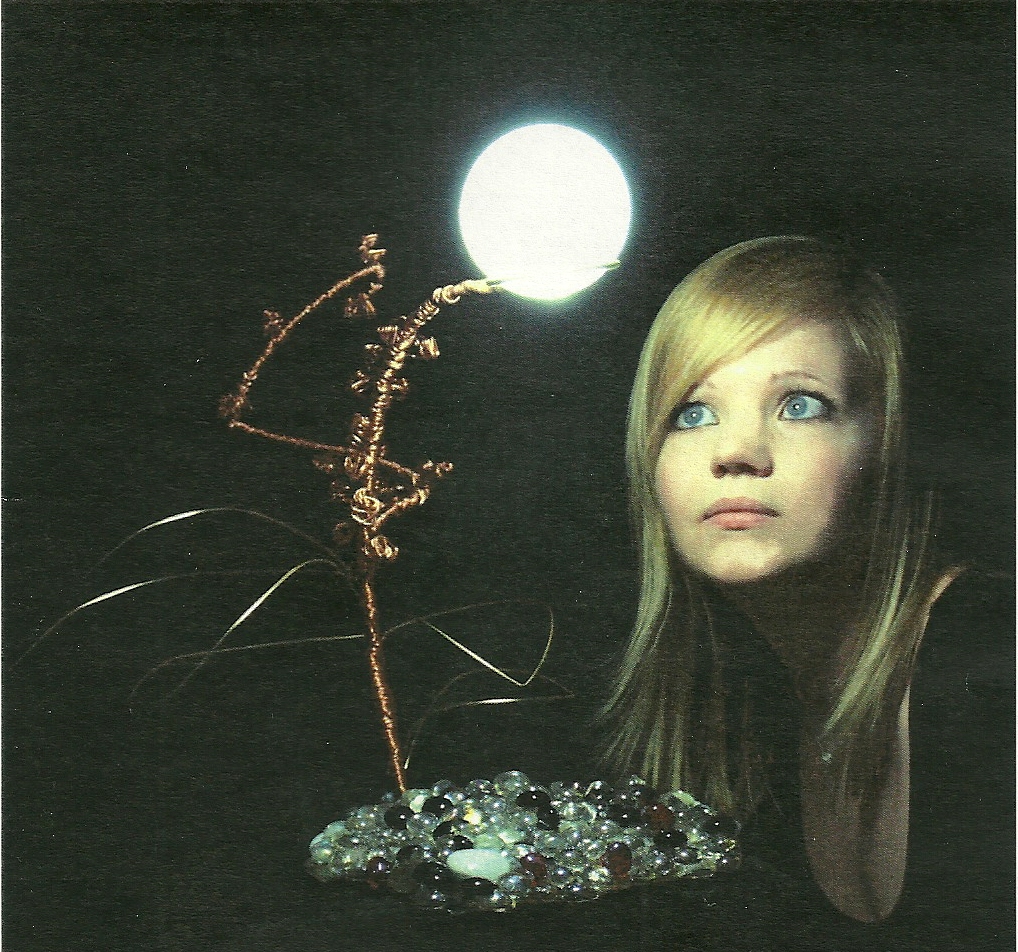
Out of hundreds of Graphic and Product designs looked at, there were three (there could have been loads more) that caught my attention.

The picture shows the Orbiculight, which is a bespoke design, tailored to meet each client's needs. According to the designer, the finished form of copper and brass was secured to a base of glass pebbles and stones, which reflect the light given off by the LED lit orb.

They also give an overall more decorative feel to the final product. I liked it.


It's a well known fact that many elderly people are prone to falls, which can cause serious damage. When someone falls downstairs, the result can be critical.

I was intrigued by the design opposite to address this problem. As can be seen in the picture, every other stair has a cushion inserted into the back board. Apparently a camera will detect the movement of falling, and the cushions will be automatically inflated.

It's obviously not designed to prevent falls, but it can stop you from being unduly hurt, as you would normally bang head or back on the stairs as you were falling down. The cushions are also robust enough to grab hold of if that were possible. The aim is to minimise the impact of falling, and I think it's a great idea. It can be installed into existing stairs, as well as into new build.

Lastly, something a bit bigger. It's a design for a double decker tram system.

Very topical for Nottingham at the moment I think. The tram itself is on two levels, without any stairs, so that space can be maximised.

Each tram stop will also have two levels, with the suggestion that disabled passengers, and those on short journeys occupy the lower level, while those on a longer journey take the upper floor. Access to the upper level of the tram is via the upper level of the stop (you worked that out didn't you?).

I could see a problem if a tram broke down between stops. With no stairs, how would the upper level passengers get out? Maybe the trams will be designed never to break down.

I like the concept of this though very much, and would be interested to see if any authority, anywhere will take it up. I hope so, because I really think it's cool.

Design seems to be alive and well, and the innovation and creativity shown by NTU students does auger well for the future. Here's hoping for their sake, and that of the country. Another good day in Nottingham.

Saturday, 4 June 2011

Expectoration

To copy the words of Stephen Fry, "I am angry. I am really angry. I am so angry I can hardly go to the lavatory". The cause of Stephen's anger was that he'd lost a sock. Mine is because I've really had enough of people spitting.

Yes, I know that there are probably more important things in the world that I could be ranting about, but just at this moment I can't think of any. Why am I suddenly so angry?

The dislike of spitting is not a new thing; I have always disliked it, but today, dislike turned to anger. I was sitting on a seat in town enjoying the sunshine and a take-away coffee - yes, I was back outside the Gala Casino. Two young men came outside the Casino for a smoke, and after almost every drag of the cigarette, they engaged in the act of expectoration - forcibly ejecting saliva from the mouth  (Spitting). It was disgusting.

Now, I heartily agree with Albert Einstein when he said, "The world is a dangerous place to live, not because of the people who are evil, but because of the people who don't do anything about it". I should have spoken to the young men, but in my pathetic defence they were much bigger and younger than I am; they would possibly have taken no notice, and may well have hit me. So I moved.

You see people spitting on the pavement all of the time don't you? And it's not just the young. If you Google saliva, and click on images, you are presented with some horrific sights. While watching football on television, you are constantly assaulted with close-ups of players spitting on the grass. Sometimes I'm surprised that the referee doesn't have to call off the match because of a flooded pitch. Have you seen American Baseball as well?

Generally, western society at least has moved on a bit from the Middle Ages, when frequent spitting was part of everyday life, and at all levels of society. It was thought ill-mannered to suck back saliva to avoid spitting, but by the early 1700's it had become seen as something which should be concealed. Wikipedia says that by 1859 (why such an accurate date?) many viewed spitting on the floor or street as vulgar. In addition to its vulgarity, spitting can spread diseases and infections such as tuberculosis, influenza and the common cold. It also looks disgusting.

Now I am perfectly aware of the importance of saliva to the human (and animal) body. In a healthy person, the salivary glands secrete about 2 to 4 pints of spit into the mouth every day. It is important for such things as;
  1. Saliva wets food and makes it easier to swallow
  2. Saliva helps begin the process of digestion
  3. Saliva cleans the inside of the mouth and rinses teeth to keep them clean
Spit is therefore highly advantageous to the human body, but that's where it should stay, in the body, not forcibly ejected from it.

Lastly, human saliva is 98% water; it won't do you any harm - swallow it.

I apologise for the unpleasant nature of this Blog, and I can only hope that you haven't tried to read it while having your tea. But you see, I was so very angry. But I'm better now.

Thursday, 2 June 2011

Gates, Tunnels and Parks

"I don't know much about history, and I wouldn't give a nickle for all the history in the world. History is more or less bunk. It is a tradition. We want to live in the present, and the only history that is worth a tinker's damn is the history we make today". - Henry Ford.

You don't believe that do you? I'm sure that with David McCullough you will say that, "A nation that forgets its past can function no better than an individual with amnesia". If you happen to agree with Henry Ford, then there will be no point in reading on, because we're going to look at two pieces of Nottingham history.

Part of the old city wall
At the top of Maid Marian Way, near the Nottingham Playhouse stands the Holiday Inn Express. I have walked past it many times, and looked in through the side windows at three large notice boards that give something of the history of the area. To my regret however, I had never looked down. There on display you see the remains of the ancient Nottingham City walls. I tried to capture it in the picture above, but it had to be taken through a thick plate glass window. The wall is part of the boundary wall that ran from Chapel Bar to around the Castle. The pavement outside shows the direction of the original wall.

Chapel Bar around 1740
Chapel Bar today is a short street the other side of the Holiday Inn Express, and is a pedestrianised area full of restaurants and outside eating areas.

The old Chapel Bar was the west gate into the walled enclosure of Nottingham, and was built around 1154. The word 'bar' is a Scandinavian word for what we would call a gate, and according to some, it reflects the fact that Nottingham was an important Danish settlement. Until 1750 the street now called Chapel Bar was known as Bar Gate, and if the above mentioned Scandinavian connection is true, it means Gate Gate. Ah well, why not? There are plenty of people in Wales called Evan Evans.

There has been lots of discussion on the meaning of the word Chapel. Some think that the northern part of the tower was used as a Chapel, while others think it relates to the division of the town, where the Gate, Angel Row, St James' Street,  Friar Lane etc was called Chapel Ward. By about 1700, Chapel Bar was little more than a ruin, and I think that the line drawing above shows something of this. The old gateway was demolished in 1743, as it was in the way of the increasing amount of traffic entering Nottingham. Two years later, as the Thoroton Society history (1931) says, "in 1745, when Bonnie Prince Charlie had got as near to the town of Derby, the authorities wished very heartily that they had not pulled it down". To show how small ancient Nottingham was, it wasn't until 1729 that any house was built outside of these walls. I know that there's not much to see, but next time you're in the area, do go and have a look at the ruined walls.

View from Derby Road
A few yards away from Chapel Bar is the start of the Derby Road, the whole length of which from Nottingham to Derby, is officially called The Brian Clough Way.

Walk a few hundred metres up Derby Road, pass St Barnabas Roman Catholic Cathedral, and you come to the vehicle entrance for a block of flats. The picture opposite shows you the path, but the entrance gives you no clue as to what awaits you if you take the path under the block of flats.

What awaits you has been described as one of Nottingham's best kept secrets. It may seem unwelcoming, and a bit dark, but walk the few metres through the car park and you come to a set of steps. Go down the steps and marvel at the sight that greets you.

View of the two tunnels from The Park
This is the Duke of Newcastle's Tunnel, cut in two stages through the Nottingham sandstone. In between the two parts, there are steps that take you up to The Ropewalk. Believe me, these steps are steep. I'm feeling worn out just talking about them.

The tunnel was built for the Duke in 1855 (though it was started in the early 1840's, but abandoned due to lack of money) to allow horse drawn carriages to travel from Derby Road to the Park Estate which he also owned (He was also the owner of Nottingham Castle, which overlooked the park).

The Duke commissioned architect T.C. Hine to construct the tunnel and develop the park for residential use. The Duke wanted a maximum gradient of 1 in 14, however, it was actually built with a 1 in 12 gradient, which was too great for horse drawn carriages, "thus", said someone with commendable understatement "defeating the object of the construction". See, there's nothing new about cock-ups.

The tunnel is wonderful, and remains much the same now as it did in the Victorian period. At one end you enter from a very busy, noisy city centre road, and emerge the other end into a quiet, genteel, countryside environment with trees, bowling greens and birds singing. If you haven't already, do get to see this tunnel - it's magic.

Images of The Park Estate
Part of the Park Estate
As has already been mentioned, T.C. Hine was charged to design and build the tunnel and the Park Estate. He was also responsible for repairs to the Castle, and its conversion into a museum.

The park was originally a royal hunting ground for Nottingham Castle which overlooks it. It had deer, game, fishponds, rabbit warren and a falconry, providing food and sport for the castle residents.

The style of homes varies greatly, and this was no doubt due to building work taking place from the 1830's to the early 1900's. The appearance of the Park Estate was maintained by covenants restricting the density of the development, and required that houses be "set back from the road among trees, and no house was allowed to be erected which would interfere with the view of another house". No business was allowed in the Park, and it was even illegal for buildings or rooms to be used by any faith other than the Church of England. Owners had to maintain their property, which included painting exterior wood every four years and agreeing to twice-yearly inspections by Hine's office.

Map of Park Estate
By 1877 the Park covered an area of 254 acres and had a population of 1500 residents. And as Michael Payne says in his 'Victorian Nottingham', "By 1887 the original scheme was complete; some 650 houses stood in semi-rural splendour on an estate less than half a mile from the centre of town, and Nottingham's merchant aristocracy had a local Belgravia all of their own".

T.C. Hine retired as estate surveyor in 1890, having overseen the majority of the Park's development. In 1938, after almost 280 years, the 8th Duke of Newcastle sold the Nottingham Park Estate to Oxford University, and almost 50 years later, in 1986, the park came into the hands of Nottingham Park Estate Limited, run by a Board of Directors elected by the residents. It became a conservation area in 1969, and over 93 of its buildings and other features are listed.

Chesterton Humberts, a firm of local estate agents describe the Park as "a quiet, picturesque area within central Nottingham, with historic features maintained, preserving the tree lined streets and grand Victorian houses".

The Park has not been without its problems though, as can be seen by reading some back issues of the Park Residents Association newsletters. The main concern seems to have been the conversion of larger houses into flats which began in the early part of the 20th Century.

These became known as Houses in Multiple Occupation (HMO's), and in 2009, the Department for Communities and Local Government opened a consultation period on HMO's and planning processes. The Nottingham Park Estate Residents' Association submitted their views in August of that year.

Now, I was involved with HMO's, planning and the views of local residents for many years, and to my shame, I approached the NPERA submission expecting it to be full of NIMBYism, but I was wrong. It was a well reasoned, well written, positive submission. Their concerns were those that I could identify with, as they were common to all areas.

Too many HMO's are poorly managed by the Landlords; property is often not looked after, and tenants behaviour is ignored. Too many HMO's in a small area tends to produce a ghetto, and is not conducive to developing a balanced community.

In early 2010, the Government said that it would be bringing in changes to the planning regulations, and giving more power and discretion to Local Authorities in how they managed HMO's.

In spite of the above, I'm sure that The Park is still a wonderful place to live, and it is certainly a wonderful place to visit. The round trip from the Castle, up Derby Road, through the Tunnel and the Estate, and up Lenton Road back up to the Castle is a joy to behold. And there's often an ice cream van waiting for you outside the Castle Gate.

By the early 1900's, you had 'arrived' if you had an address in The Park. Residents have included Sir Jesse Boot, founder of Boots The Chemist; artist and first woman to be elected to the Royal Academy, Dame Laura Knight; Director, Sir Jonathan Miller; Fighter Pilot awarded the VC, Albert Ball; Founder of the Raleigh Cycle Company, Sir Frank Bowden; fashion designer, Sir Paul Smith, and actor, Hugh Grant.

Mind you, if you want to live in The Park, it's not cheap. On sale today is a 3 bed terrace house for £329,000, or a 3 bed period residence for £429,000. If you turn your nose up at such cheap properties, then you may wish to look at one selling today for £1,420,000.

Winston Churchill said, "History with its flickering lamp stumbles along the trail of the past, trying to reconstruct its scenes, to revive its echoes, and kindle with pale gleams the passion of former days".

Oh, I do hope that we have succeeded just a little bit on this journey through Gates, Tunnels and Parks.