Sunday, 15 May 2011

My Village, My Home, My Life - part seven

1947 was a year of contrasts, and of beginnings. We had BUPA founded; the first tubeless car tyre; first transistor produced; a record football transfer fee of £15,000; Llangollen International Eisteddfod began; harsh winter; hot summer, and I was born.

Digging out a car, 30th January 1947
According to Met Office records, from the 22nd January to the 17th March 1947, snow fell every day, somewhere in the UK. In my County of Denbighshire, snow fell to a depth of about 5 feet, with drifts in exposed places reaching over 15 feet. There was inevitable chaos for a number of weeks. Men couldn't get to work in the area, and the mines had to close, with the looming threat of coal shortages. There was still rationing after the war, and the snow caused additional food shortages.

Hill farmers faced the threat of losing their flock of sheep due to the depth of snow on the mountains. And this is where I love stories of communities coming together in the face of adversity. Many miners and others who could not get to work because of the closures, went out on the mountains to help farmers find and recover their sheep. It seemed a daunting task, but experience had told farmers to look for dark brown patches in the snow. Sheep would lift their nostrils as high as possible to sniff the air, and the brown patches would indicate that sheep were near the surface of the snow. Many sheep died, but many were saved because of this collective community action.

You can't get to Penycae without either walking over the mountains, or going up steep hills, so the village was cut off for a considerable time.

I was born in September 1947, which means that unless I came about as the result of an immaculate conception, I was conceived around January 1947. This set me thinking; was I conceived because there was nothing else to do in a snow bound village? Oh, do tell me that there was more to my conception than that. Unfortunately, we'll now never know.

In March the snow began to melt, but because of the hardness of the ground, there was nowhere for the water to go, so inevitable widespread flooding occurred. Of interest to Nottingham readers is the fact that on the 18th March 1947, the banks of the River Trent burst, and hundreds of homes were flooded, many to first floor level.

After coping with deep snow in the early period of carrying me, my Mother had to endure the latter stages of pregnancy in a heatwave. The Summer of 1947 is the 6th warmest since records began in 1659. (You're dying to know the other five, aren't you? Well, 1826, 1846, 1976, 1983 and 1995). September 1947 was the 20th warmest month since 1659. I can imagine that after the snow of Winter, and the heat of Summer, my Mother would be relieved to see me pop out into the world.

LLangollen North Wales
Another significant event in 1947 was the first Llangollen International Eisteddfod, held in the magically beautiful town of Llangollen in the Dee Valley, just a short hop over the mountains from Penycae. The picture shows the centre of the town with its white water rapids at high level, and you follow the road to the right of the river, which takes you past the Eisteddfod ground, and on up to the ruins of Valle Crucis Abbey and the Horseshoe Pass.

Eisteddfod Pavilion
The Eisteddfod Executive Director says, "One of the joys of Llangollen is that it brings together in friendly competition some of the finest musical talent the world has to offer".

For one week in July each year, between 2000 and 5000 musicians, singers and dancers compete in over 20 high quality competitions during the day.

Every evening, the best and most colourful competitors share the stage in renowned concerts given by professional artists, many of whom started their careers in Llangollen.

It amazingly did not take many years to get established. Argentina and China participated in 1948; USA and Germany in 1949 (remember this was just four years after the end of the 2nd World War, but they were welcomed to the Eisteddfod with open arms); Brazil, Sri Lanka and Turkey in 1950; India and Indonesia in 1951. By 1953 - just six years after it started, 50 countries had competed in Llangollen. 2011 marks the 65th anniversary of this truly international festival.

Luciano Pavarotti (circled) Llangollen 1955
If you don't know the Llangollen International Eisteddfod, don't ever think of it as some mickey mouse event, held in the back waters of Wales. There is a seemingly endless list of now household names who have performed on the famous stage.

Placido Domingo acknowledges that his first professional experience in the United Kingdom was at the 1968 International Eisteddfod, and in 1955 Luciano Pavarotti (see picture), at the age of 17 competed with his father in the male voice choir competition with others from their home town of Modena. They won, and Pavarotti returned for a spectacular concert in 1995. Other stars who have appeared in the Gala Concerts are, Kiri Te Kanawa, Jose Carreras, Lesley Garrett, Bryn Tyrfel, Katherine Jenkins, Dennis O'Neil, James Galway, Nigel Kennedy, Elaine Page, Michael Ball and Montserrat Caballe. A truly glittering array of musical stars.

South Korean Dance Group
For this years Eisteddfod, 103 choirs and dance groups have been selected to participate from 35 different nations around the world. If you can get there, go and enjoy the spectacle of dance and song.

With so many people coming for a week to compete, where are they all to stay? The answer has always been in finding host families in the towns and villages around Llangollen. Penycae was one of those villages for many years, though for some reason, we were never a host family ourselves. Each nationality was allocated to a village, and as children, we waited with great excitement and anticipation which nationality of choir or dance group was allocated to the village.

Whichever group it was, at the end of their stay they would put on a concert for the village as a way of saying thank you. Weather permitting, the concert would be held on the green in the estate opposite my house in Cristionydd, called Groesfan. There would also be some gifts for the children, and I remember the Americans being my favourite, as they gave out loads of sweets and chocolates (like in the war with nylons, cigarettes and chocolates). Children can be so selfish can't they? I don't think that I can have changed that much, as I can still be easily bought with coffee, ice cream and chocolate.

I don't have first hand accounts from host families in Penycae, but in trawling through websites for memories of the Llangollen Eisteddfod, I came across a memory from someone in a neighbouring village, which could well be duplicated in ours. I love this recollection from 1977 as it shows how different nations lived at the time, and how Llangollen brought people together. The writer says,

"Another memorable year in the Eisteddfod calendar was when the Zulus, from Durban in South Africa arrived. My aunt hosted two young female competitors. My cousin recalls calling at the parish hall in their car to collect them. On reaching home it became obvious that the two young ladies were not at ease, with the situation becoming even more tense when they were asked if they would like something to eat.

Finally, when they were shown to their room, they broke down and confessed that they had never been treated so courteously, especially to be waiting on. The final straw came when they realised that they would be sleeping in the same house as a white person. It turned out that this was not an isolated case in the village, as other Zulu members asked shopkeepers if they could enter the premises to be served".

Remember, this was 1977, and at the time, apartheid was the official government policy of racial segregation in South Africa. Llangollen International Eisteddfod was there to embrace the world. Colour, creed and nationality were of no importance, the only thing that mattered was talent, and the world was brought together in healthy competition. For one week in July every year, Penycae embraced that vision, and while I can't speak for anyone else from the village, that vision has remained with me until this day.


Sorry, but couldn't resist ending with a shot of a Male Voice Choir.

Saturday, 14 May 2011

Blogging and the Blogosphere


I'm fairly new to the blogging game, having started a site in December 2010. All blogs and their interconnections make up the term Blogosphere - originally coined in 1999 as a joke, but is now in common usage. For the classicists among us, the word comes from two Greek words meaning, "the world of words". I rather like that, don't you?

Blogs exist together as a connected community in which everyday, authors can publish their opinions. And what a community this is. The website BlogPulse catalogues all manner of information from blogs, and has a running total of the number of blogs at any one time.

Did you know that worldwide;
  • As at the 14th May 2011, the total number of blog sites is, 161,819,001
  • In the last 24 hours, the number of new blogs coming on line was 64,452
When we were thinking of starting a blog, many of us asked whether the world needed another blog. I've come to the conclusion that with over 161,000,000 blogs already out there, another one will not make much difference to the total.

I doubt that there isn't a subject out there that someone isn't blogging about it. Though there are hugely popular sites promoting the likes of business, politics and so forth, I wonder how many of the huge number are like mine; just personal diaries really, outlining personal opinions that very few people will ever read. For many of us the value is in writing the blog, rather than the fact of someone actually reading it. Of course, when you hear that someone has read your blog, and passed comment on it, that is an added bonus.

Also, as a blogging friend of mine (this is a new category of relationship) puts it, "One of the joys of blogging is reading the blogs of others - and discovering their enthusiasms or opinions". I read many other blogs, and try to select them on the basis of a variety of subjects. They could be specific to politics, religion, sport, education, music or miscellaneous, where the author covers a whole range of subjects. Mine is in the latter group, with a mixture of some rants, some observations, and some memories.

That's the beauty of a blog; we write about our opinions, and our opinion is just as valid as the next persons. Specialist, professional blogs can be most useful in keeping up with what is happening in particular specialist fields. My son blogs a lot on education and music and they constantly challenge the old brain cells.

However, I do like to balance the more professional works with those from people who are simply doing it from home, and talking about matters that have been personal to them. If you sat on a park bench and spoke out loud what you write in a blog, you could be accused of disturbing the peace, but nobody has to read your blog. It's not harassing people. Of the many beauties of blogging, and reading blogs, one is that you are constantly learning things. I may be a bit OTT here, but I think that in the last six months, in preparing for and writing blogs, I have improved my general knowledge more than at any time over the last ten years.

Inevitably with over 161,000,000 blogs they are not all edifying, instructive or a delight to read. Many are harmful, abusive and full of personal vitriol, and all done in the name of free speech.

Even some blogs dealing with high profile subjects, and written in an acceptable way, are often spoilt by people in the comments section. Now vitriolic responses to a blog by others, is not something that I think I'll have to worry about, as my readership is probably in single figures, and I may know most of those people.

Why can't people who disagree with what has been written do it with civility and without violation? Why abuse another because you disagree with their opinion? I don't know if you look at some of the BBC football writers blogs, where they comment on this team, or that player, then read the hundreds of comments that they receive, many are abusive and personally comment on the writer, and this is after many each day are not published because they have broken the 'house rules'. I've stopped reading the comments sections on a number of blogs that I follow, because it gets me so angry. Why do writers of blogs, and those who comment on the blogs have to be at times so thoroughly unpleasant? This is not what free speech is meant to be.

For a number of years, others have been similarly concerned, and in 2007, Tim O'Reilly proposed a voluntary Blogging Code of Conduct, which would be guidelines that bloggers would sign up to. In reading hundreds of adverse responses to his draft Code, I'm not surprised that it doesn't seem to have progressed very far. Many sites do of course have their own set of standards and house rules, but Tim wanted to make it easy for people, and to encourage every blogger to have a set of guidelines.

The code was proposed due to threats made to a well known female blogger. In speaking to BBC News he said, "I do think we need some code of conduct around what is acceptable behaviour; I would hope that it doesn't come through any kind or regulation, it would come through self-regulation".

Face used for an Internet Troll
O'Reilly and others came up with a list of proposed ideas that bloggers could use to enforce civility on their blogs by being civil themselves and moderating comments on their blog.
  • Take responsibility not just for your own words, but for the comments you allow on your blog
  • Label your tolerance level for abusive comments
  • Consider eliminating anonymous comments
  • Ignore the trolls
  • Take the conversation off-line, and talk directly, or find an intermediary who can do so
  • If you know someone who is behaving badly, tell them so
  • Don't say anything online that you wouldn't say in person
In case you're as ignorant as I was about a Troll, it turns out to be Internet slang for someone who posts inflammatory, extraneous, or off-topic messages in an online community (such as a blog) with the primary intent of provoking readers into an emotional response, or to otherwise disrupting normal on-topic discussion. The draft Code says, "We believe that feeding the trolls only encourages them - 'Never wrestle with a pig. You both get dirty, but the pig likes it'. Ignoring public attacks is often the best way to contain them".

I am happy with self-regulation. I want my blogs to be challenging, written as well as I can, and informative, but never abusive towards others. I also want any comments to be treated in the same way. I guess that this is a kind of code of conduct, and why should there be anything wrong with that? Good blogging achieves so much, and the freedom we enjoy in blogging should never be abused. What do you think?

I finish with this cartoon, for no other reason than I can, and I like it.


Keep on enjoying the "World of Words".

Friday, 13 May 2011

My Village, My Home, My Life - part six

Painting by J Davies, Penycae
Wales is often described as the land of song, but I prefer to see it as wider than that, and call it the land of culture. This can be seen in all walks of life, and in many different ways. The above painting of various scenes in and around Penycae was done by John Davies, who has lived in the village all of his life. He was affectionately known as "Johnny Paraffin" (Wales does like its nicknames), as for as long as I can remember he drove a van around the village and surrounding area to deliver paraffin and a variety of household goods. He could talk for Wales on any subject, and never seemed to be in a hurry to get to the next customer. He was also a leader at Zion English Baptist Chapel (which I've mentioned before), and I shall be eternally grateful for the help and support he gave to me in my early development. He is now part of Penycae Art Club, which shows how important it is to document the life and history of a village, whether in painting, prose, poetry or song, while people are still alive.

The culture of Wales is very much kept alive through the Eisteddfodau (singular is Eisteddfod) held every year. There are two main ones: The Royal National Eisteddfod of Wales (very much Welsh language), and the Llangollen International Eisteddfod (promoting culture from across the world). In 1961 I was part of the National Eisteddfod when it came to my area, but more of that later. I'll also mention the International Eisteddfod, and its relation to the village in another blog.

The word Eisteddfod literally means 'eistedd' (to sit), and 'fod' (to be), so its historic meaning is The Sitting. I believe that this refers to the early days when 'judges' sat in a circle with the performers in the middle. The National Eisteddfod is the home of literature, music, dance, recitation, theatre, visual arts, science and technology, and all types of culture in Wales. Its purpose is to encourage the preservation of Welsh music and literature, and only those who sing or write in Welsh may enter the competitions.

Eisteddfod Field
Eisteddfodau have been in existence for hundreds of years. It is believed that the first Eisteddfod was held in Cardigan Castle in 1176. Records then show Carmarthen in 1451; Caerwys in 1568, and Corwen in 1789, which was the first time that the public were admitted.

The modern National Eisteddfod is very much from the 19th Century, and I have a theory as to what was one of the driving forces for change. The Government (in London) commissioned a report which had the title, "Reports of the Commissioners of Enquiry into the State of Education in Wales", which was published in 1847. The commissioners visited every part of Wales in 1846 gathering evidence and statistics. One of the problems, though, was that none of them spoke Welsh, and teachers and children did not speak English. The commissioners relied on information from witnesses, many of which were Anglican clergymen, at a time when Wales was a stronghold of Nonconformism. The report was not complimentary, and was not helped by a conclusion which said that " the Welsh were ignorant, lazy and immoral, and that among the causes of this were the use of the Welsh language and nonconformity".

The Blue Books
The report was presented to Parliament on the 1st July 1847 in three large blue-covered volumes, which resulted in a furious reaction. In Wales, the report was given the name, "The Treachery of the Blue Books". Robert Jones Derfyl, a Bard, wrote a book-length response, which some historians say was instrumental in the genesis of the modern Welsh self-government movement.

The general public felt that the report was an attack on the character of the Welsh as a nation, and the belief grew that it was important for the Welsh to create a new national image. In the 1850's people were talking of a national eisteddfod to showcase Wales' culture. One was held in Llangollen in 1858, and only three years later, in 1861 the modern, annual National Eisteddfod of Wales was born. 2011 marks the 150th anniversary of that date, and this years Eisteddfod is being held in Wrexham, just 5 miles away from my village, my home.

Wrexham Eisteddfod Proclamation Ceremony, 3rd July 2010
According to tradition, the intention to stage an Eisteddfod must be announced at least one year and a day before the actual event. On the 3rd July 2010, this is what happened in Wrexham. A procession of over 1200 people marched through the town centre, concluding with the proclamation ceremony.

At the heart of every National Eisteddfod are the Bards and the Gorsedd. Bards go back hundreds of years, and in their simplest form are poets and musicians, many of whom were professional, in that they were employed in the service of some Lord. The Gorsedd is a community or coming together of modern-day Bards. They hold the right of proclamation and of governance, while the Eisteddfod Council organises the event.

Ranks of the Welsh Gorsedd


There are three ranks of membership in the Welsh Gorsedd.
  • Ovates - who wear green robes
  • Bards - who wear blue robes
  • Druids - who wear white robes


The Bard's Chair

There are three Gorsedd ceremonies at every Eisteddfod, which happen at the end of the three main competitions.
  • The Crowning of the Bard - awarded to the poet judged best in the competition in free meter
  • The Awarding of the Prose Medal - for the winner of the prose competition
  • The Chairing of the Bard - for the best long poem
A new bardic chair is specially designed and made for each Eisteddfod, and is awarded to the prize-winning Bard each year.

Eisteddfod 1961
When I was 13, in 1961, the National Eisteddfod came to Rhosllannerchrugog (the Rhos) just one and a half mile from Penycae. With a population of around 10,000 people, it was one of the largest villages in Wales. Because of its built up nature, the Eisteddfod was held on the outskirts of the village on the fields of Rhosymedre.

I was attending Rhos Secondary School at the time, and somehow we entered a group in the Choral Speaking competition, and I was a member. Choral Speaking, for those unfamiliar with it, is projecting your voice and speaking in chorus. Imagine the finest choir. Take away the music and the singing, and just speak the words. I have always loved this form of art, and when done at best, it is powerful, evocative, intense and very moving. I have looked up some choral speaking on the Internet, but to be honest they were mostly rubbish, and I refuse to give a link in case you become tainted. I have no idea how we did in the competition, but as I had by then begun to love public speaking, I'm sure that performing on stage in front of thousands was a magical experience.

Not much about me or my village I know, but there is a link, and I hope that having a brief look at the magic of the National Eisteddfod is of some interest. This year in the Eisteddfod in Wrexham, there will be stiff competition for the three main prizes. The entries received are;
  • For the Crown = 35
  • For the Chair = 13
  • For the Prose Medal = 11
I think that Marcus Garvey is right, "A people without the knowledge of their past history, origin and culture is like a tree without roots".                                                       

Wednesday, 11 May 2011

Huang Yong Ping

One of the delights of retirement is being able to do things that there never seemed the time to do before. After nearly 50 years of constant work, I did take quite a bit of time to adjust to the new life. I do miss the salary coming in, but that couldn't go on for ever. I certainly don't miss the pressures of work, and really appreciate the time available to read more, attend music evenings, see more of family, make new friends, visit new places, and to write. The latter is becoming a bit obsessive, but hey, I love it. To have time for a wide range of interests makes you a more rounded person I think. (Please, no comments about my girth). I'm finding that Nottingham and district is giving me all that I'm looking for at this present time, and to think that previously all I knew about was Robin Hood. There is so much more to do and see in this wonderful place.

Nottingham Contemporary
Travelling into town today, I decided to get off the bus at the Lace Market and see what was on at the Nottingham Contemporary. I decided that this would be one of my art days, as I'm still fairly clueless about the meaning of it all. Currently there is an exhibition by HUANG YONG PING (more of which later).

External Lace Effect Walls
Nottingham Contemporary was opened on the 14th November 2009, and is one of the largest contemporary art centres in the UK. It is undoubtedly an impressive building, but I'm still struggling to decide what I think about it.

The building was designed by award winning architects Caruso St John, based in London. The site is said to be the oldest in the city - it was the site of a Saxon fort, a medieval Town Hall, and finally a late Victorian railway cutting. The steps at the side of the building have recreated a historic right of way.

The architects, in explaining their design, say, "The site of the new building is in a part of central Nottingham called the Lace Market, whose history and built form has parallels with the cast iron district of New York, giving the centre a loose cultural connection to its site. In our design, we set out to offer a wide range of interiors that will have the variety and specificity of the found spaces of a factory or warehouse, within a new building: rooms that will change the installation and production of contemporary art and offer new ways for performers and audiences to interact. The exterior of the Centre takes its inspiration from the amazing 19th century buildings of Nottingham, and in particular, from the impressive facades of the Lace Market".

Granted that I'm a layman in these matters, and having already stated that the building is impressive, I don't want to come over all Prince Charles here. I love the Lace Market with its fantastic buildings, and I just think that the Nottingham Contemporary building is out of keeping with its surroundings, albeit that its on the edge of the area, rather than right in the middle of it. However, that's only my view, and contemporary art can get away with murder. But, it's up and running now, and is there to be enjoyed, and additionally in my case to be puzzled over. Who ever said that art appreciation comes easily.

Huang Yong Ping
So what of the exhibition that I saw? It will come as no surprise to learn that I'd never heard of the artist before today, and lest you think that I've become all pretentious and 'arty', the descriptions of the exhibits mainly come from the exhibition catalogue and from the artist himself. Please direct any questions to the Director of Nottingham Contemporary.

Huang Yong Ping was born in Xiamen, Fujian Province, China in 1954. He graduated in 1982 from Zhejiang Academy of Fine Arts in Zhejiang Province, China.

Because of turmoil in China, and the reaction to some of his work, he moved to France in the late 1980's, where he lives today, though making frequent visits to his homeland. He is described as a contemporary visual artist, though because of the size of much of his work, they could best be called 'installations'. I'll draw attention to three of the exhibits, and the rest you'll have to see for yourself.

Bat Project IV, 2004
Bat Project is a series of related works created between 2001-2004. They refer to an incident in 2001 when a US spy plane collided with a Chinese fighter jet in Chinese airspace. The US plane - an EP3 packed with sensitive surveillance equipment - was forced to land and its 24 crew were arrested. The Chinese fighter jet crashed and its pilot is presumed to have died. A diplomatic wrangle followed, but eventually the US was allowed to dismantle its plane and ship the pieces home, as the two countries attempted to paper over the cracks of a newly emerging economic relationship. Bats now roost in the cockpit - an allusion to the bat logo on the tail of the spy plane, but also a direct reference to the cultural differences between East and West. In Chinese mythology bats symbolise happiness and good luck. They are also credited with healing sight defects. In the West they represent the furtive threat of the night.

Huang Yong Ping says, "If the spy plane had been repaired and openly and honourably flown back to the United States, it would have been a rather ordinary and dull ending. When an airplane is dismantled and transported by another aircraft, however, the whole process in itself resembles a 'work of art' in my eyes. It was censored many times, and artistic creation was caught up in the complex, ambiguous games of international diplomacy, internal policy and individual identity".

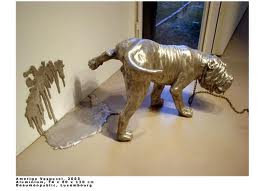
Amerigo Vespucci, 2003
Commenting on this installation, Huang Yong Ping says, "An Italian-bred bulldog, the Neopolitan mastiff (mastino napoletano) is used here as a metaphor for Amerigo Vespucci, the Italian who documented the discovery of the American continent, and after whom America was supposedly named.

The bulldog's urine forms the geographical outline of America in an instantaneous and accidental way. Here the line between the wall and the ground represents the world's longest straight border (the United States - Canada border). Its fluidity implies extensiveness and overflowingness. It is an example of all 'limits' and 'borders'".

Marche de Punya
(The Market of Merits and Virtues), 2007
The Market of Merits and Virtues, 2007
The market stall is typical of a small street shop in China. This one sells Buddhist statues, incense, candles and fake banknotes used as offerings to the dead.

In keeping with a rapidly expanding economy it has diversified - selling brooms and household goods too. It is a market of 'merits and virtues', or punya - the image of China's economic prosperity.

The elephant is often the guardian of Buddhist temples and a symbol of mental strength. Here it lies dead, overpowered perhaps by market values.

"Religion today is not disappearing, it is stepping back. Another way of looking at this withdrawal is that it now has a substitute ... globalisation itself". - Huang Yong Ping.

So there you have it. An exhibition well worth seeing. I've visited Nottingham Contemporary a number of times, and I believe that this may well be the first time I've come away saying that I liked that, and that I could see what the artist was getting at. Have I really just said that? There may well be artistic hope for me yet.

Tuesday, 10 May 2011

Wootton Bassett Repatriation

Wootton Bassett High Street
Last night I watched the BBC 1 documentary called 'Wootton Bassett - The Town That Remembers', which looked at the way the town has honoured the war dead. I knew that it would upset me, and sure enough it did. It was an extremely moving piece of television, and being the old softy that I am under the surface, I spent the whole programme dabbing my eyes with my handkerchief. The programme was focusing on the living, but all I could really think about were the dead.

As many of you are probably aware, Wootton Bassett is a small market town in Wiltshire, with a population of just over 11,000. It started to come to prominence in April 2007 when the residents began to solemnly and quietly stand at the side of the road to pay their respects to the war dead, who's coffins were passing through the town on their way from RAF Lyneham. The bodies of fallen soldiers arrived at the air base, and were driven through Wootton Bassett on their way to the mortuary at the John Radcliffe Hospital in Oxford.

Repatriation flights, as they are called, will cease to land at RAF Lyneham from about September 2011, as the air base is due to close in 2012. All flights we be transferred to RAF Brize Norton, which is in Carterton, about 22 miles west of Oxford. It is unlikely that we will see many more days as we have in Wootton Bassett, as the route from RAF Brize Norton to the mortuary in Oxford does not pass through any towns or villages. Some residents apparently will not be too disappointed about this, as they feel it has become too much of a media event, and has attracted what they call "grief tourists". These views may well be in the minority, and though the programme revealed that there was perhaps more organisation needed than I would have at first thought, the dignified respect for those who had died, and the support given to grieving families will be missed. One side effect of these days is that it helps to keep in the public eye, the constant death toll as a result of war, and without it, we might just be left with hearing a brief statement from the Prime Minister at the beginning of Prime Minister's Question Time every week - an altogether more limited audience.

Wootton Bassett
I'll come to my feelings about war in a moment, but the harsh reality is that we are engaged in wars, and as a result of the inevitable deaths that occur, Wootton Bassett residents should be remembered for their dignified actions.

It seems that the Queen agrees, as she has conferred on the town the name Royal, so from later this year the town will be known as Royal Wootton Bassett. I have no idea what this means, or whether there are any perks associated with it, and to be honest, I haven't enough interest in the subject to look it up.

Did you know though that there are only two other towns in England that are Royal towns? They are Royal Leamington Spa (given the title in 1838) and Royal Tunbridge Wells (given the title in 1909). Also, never one to miss an opportunity to mention Wales, Caernarvon in Wales is a royal town of a different kind. "The Royal Town of Caernarvon" was made a Royal Borough by the Queen in 1963, and was allowed to retain the honour when it ceased to be a borough in 1974. Not quite in the same league that one I think.

That's the niceties over with. Repatriation happens because of dead soldiers. Dead soldiers happen because of war. War happens because someone decides to make that decision. In the last ten years, we have gone to war in Iraq and Afghanistan. So that you know where I stand, I opposed going to war in both countries. We went into Iraq in March 2003, to deal with Saddam Hussein's 'Weapons of Mass Destruction' - which we never found. Tony Blair, at the Chilcot inquiry into the Iraq War was unrepentant, saying that going into Iraq had, "Made the world a safer place". This is highly questionable, and it has yet to be shown that the dossier in support of the war was not doctored. In other words, some people lied. Since March 2003, when we went to war, 189 British soldiers have been killed. More of that later.

We went to war in Afghanistan in October 2001, to destroy the Taliban; make it harder for Al-Qaeda, so making the world a safer place. Last month the 364th British soldier was killed. David Cameron said to Channel 4 news, "We are paying a high price for keeping our country safe, for making our world a safer place. We should keep asking why we're there and how long we must be there. The truth is we're there because the Afghans are not yet ready to keep their own country safe and to keep terrorists and terrorist training camps out of their country. That's why we have to be there. But as soon as they're able to take care and take security for their own country, that is when we can leave".

A former British forces commander in Afghanistan, commenting when the 300th death had been reached, said, "The death rate in Afghanistan seems shocking. But casualties are a brutal reality of all wars. And compared to many previous conflicts the figures in this nine year campaign are low. In the Falklands we lost over 250 troops in under three months. Almost 700 British soldiers were killed during the three years of the Korean War. And on average, 178 died every single day in the six years of the second world war. Even in the Northern Ireland police action, in 1972 alone we had as many killed as in the bloodiest year in Helmand". So that's all right then. Tragic as it is, it's not as bad as previous conflicts. Sorry, this is pathetic.

Afghanistan Tribes People
What of the people of Afghanistan? How involved are they in the decisions made affecting their country. It is said that about 90% of the opium produced in the world comes from Afghanistan. This must be destroyed so that the 'drugs problem' around the world can be dealt with. But for most people living in the rural tribal heartlands this is their only source of income. What will replace it? The answer is? It seems that nobody knows. If destruction of opium fields is a policy, then it has patently failed, for reports state that since the war began in 2001, there has been a 150% increase in Afghan opium production.

A searching Blog, written by Alex Thompson, Chief Correspondent at Channel 4 News, at the time of the 300th British soldier to die says, "You will no doubt hear and read a lot today, an awful lot today, from Englishmen intent on saying that the war in Afghanistan is going well. You will hear almost nothing from Afghans. And Afghans, thanks to NATO and the Taliban/resistance/insurgents (delete as applicable to your own personal prejudice) are getting wiped out and injured far, far more than any foreign soldier or insurgent mujaheddin. Which is rather a shame. Because tragic though the 300th British dead soldier/marine is, it is the Afghan people for whom we are fighting we are told, and the Afghan people who remain resolutely ignored in what is being forced upon them and their land from the foreign occupation (and it is that for many of them, let's not beat about the bush) and their largely hated, corrupt president, downwards through the various levels of corruption and kleptocracy. All of this, by a military force which keeps telling the Afghan people that it wants to get out and run home as fast as it feasibly can".

Lest you be mistaken, this Blog is not about war in general; it is about the justification for going to war in Iraq and Afghanistan, and of our continued presence there. In my simple view, the case for going in the first place, and for staying in the second has not been made, and Wootten Bassett repatriations are a stark reminder of that. Let me conclude this Blog with a comment about the cost of war, both in monetary, and in human terms.

Monetary Cost
  • Iraq War - this had cost the UK £8 billion. In addition, the Chilcot Inquiry into the Iraq War, up to March 2010 cost £2,237,700 (official Government figures), and as another year has gone by, you can double that. Security to allow Tony Blair's first attendance at the Chilcot inquiry cost the police £273,000, and a similar amount for his second appearance (Met figures).
  • Afghanistan War - up to the latest figures, this has cost £12 billion, and rising every day. In an age when we are reducing the Government deficit, our reduced benefits, pensions, jobs and services are paying for us to continue with the war.
Human Cost

Let's not be parochial here and only concern ourselves with our own country. Many others have suffered greatly. I've trawled the Internet sites that specifically catalogue the human cost of war, particularly those sites that try to verify every statistic. The figures are frightening, and not what you hear talked about. These are figures provided as of 3rd May 2011.

Casualties in Iraq
  • Iraqi troops killed = 30,000
  • Iraqi troops seriously injured = 90,000
  • Iraqi civilians killed = 864,531
  • Iraqi civilians seriously injured = 1,556,156
  • US troops killed = 4,414
  • US troops seriously injured = 31,882
  • Other coalition troops killed = 318 (UK 189)
  • Other coalition troops seriously injured = 2,296
  • Contractors killed = 933
  • Contractors seriously injured = 10,569
  • Journalists killed = 142
  • Total killed in Iraq = 900,338
  • Total injured in Iraq = 1,690,903
Casualties in Afghanistan
  • Afghan troops killed = 8,587
  • Afghan troops seriously injured = 25,761
  • Afghan civilians killed = 8,813
  • Afghan civilians seriously injured = 15,863
  • US troops killed = 1,140
  • US troops seriously injured = 3,420
  • Other coalition troops killed = 772 (UK 364)
  • Other coalition troops seriously injured = 2,316 (UK 388)
  • Contractors killed = 298
  • Contractors seriously injured = 2,428
  • Journalists killed = 19
  • Total killed in Afghanistan = 19,629
  • Total injured in Afghanistan = 48,644
So, is it all worth it? Not to me it isn't. Let me conclude with words from a 94 year old war veteran, connected with the Wootton Bassett British Legion, and who was part of the BBC documentary.

"The saddest thing is that these soldiers should not be there in Afghanistan. I don't believe they are defending our country. This war is not our own - we should not be going into another nation, another culture, like this".

Monday, 9 May 2011

Hugh Laurie Sings the Blues


I went into Nottingham today and treated myself. I didn't get an Indian Head Massage or a Pedicure. I bought a CD. An everyday occurrence, I know for many, but for me it was a treat. I can't remember the last time I went out and paid full price for a CD. It was so worth it though, as I'd been waiting a couple of months for Hugh Laurie's debut album, "Let Them Talk". I've just finished listening to it while tapping away on the computer, and WOW.

CD Cover
In the album notes, Hugh Laurie writes about why he's playing the Blues. "I was not born in Alabama in the 1890's. You may as well know this now. I've never eaten grits, cropped a share, or ridden a boxcar. No gypsy woman attended my birth and there's no hellhound on my trail, as far as I'm aware. Let this record show that I am a white, middle-class Englishman, openly trespassing on the music and myth of the American south.

One day a song came on the radio - I'm pretty sure it was 'I can't quit you baby' by Willie Dixon - and my whole life changed. A wormhole opened between the minor and major third, and I stepped through into Wonderland".

You'll have to read the rest of the album notes for yourself.

Blues and Jazz have been my favourite genre's for as long as I can remember, and in this album, Hugh Laurie brings some of the older Blues songs back to life, backed by a brilliant set of musicians. There are 15 songs, and I particularly like; St James Infirmary; Buddy Bolden's Blues; Swanee River; Tipitina and Six Cold Feet.

From the album notes
How did the Blues begin? So much has been written about this, and there doesn't seem to be a definitive answer. However, I do like the story of W.C.Handy. The following account is taken from a PBS Teaching Programme in America on the subject of the Blues.

"On a lonely night in 1903, W.C. Handy, the African American leader of a dance orchestra, got stuck waiting for a train in the hamlet of Tutwiler, Mississippi. With hours to kill and nowhere else to go, Handy fell asleep on a hard wooden bench at the empty depot. When he awoke, a ragged black man was sitting next to him, singing about "goin' where the Southern cross the Dog" and sliding a knife against the strings of a guitar. The musician repeated the line three times and answered with his instrument.
Intrigued, Handy asked what the line meant. It turned out that the tracks of the Yazoo & Mississippi Valley Railroad, which locals called the Yellow Dog, crossed the tracks of the Southern Railroad in the town of Moorehead, where the musician was headed, and he'd put it into a song.
It was, Handy later said, "the weirdest music I had ever heard."
That strange music was the blues, although few people knew it by that name. At the turn of the century, the blues was still slowly emerging from Texas, Louisiana, the Piedmont region, and the Mississippi Delta; its roots were in various forms of African American slave songs such as field hollers, work songs, spirituals, and country string ballads. Rural music that captured the suffering, anguish-and hopes-of 300 years of slavery and tenant farming, the blues was typically played by roaming solo musicians on acoustic guitar, piano, or harmonica at weekend parties, picnics, and juke joints. Their audience was primarily made up of agricultural laborers, who danced to the propulsive rhythms, moans, and slide guitar.
In 1912, Handy helped raise the public profile of the blues when he became one of the first people to transcribe and publish sheet music for a blues song—"Memphis Blues." Eight years later, listeners snapped up more than a million copies of "Crazy Blues" by Mamie Smith, the first black female to record a blues vocal. This unexpected success alerted record labels to the potential profit of "race records," and singers such as Ma Rainey and Bessie Smith began to introduce the blues to an even wider audience through their recordings.
As the African American community that created the blues began moving away from the South to escape its hardscrabble existence and Jim Crow laws, blues music evolved to reflect new circumstances. After thousands of African American farm workers migrated north to cities like Chicago and Detroit during both World Wars, many began to view traditional blues as an unwanted reminder of their humble days toiling in the fields; they wanted to hear music that reflected their new urban surroundings. In response, transplanted blues artists such as Muddy Waters, who had lived and worked on a Mississippi plantation before riding the rails to Chicago in 1943, swapped acoustic guitars for electric ones and filled out their sound with drums, harmonica, and standup bass. This gave rise to an electrified blues sound with a stirring beat that drove people onto the dance floor and pointed the way to rhythm and blues and rock and roll.
In the 1940s and early 1950s, the electrified blues reached its zenith on the radio, but began to falter as listeners turned to the fresh sounds of rock and roll and soul. In the early 1960s, however, as bands like The Rolling Stones began to perform covers of Muddy Waters and Howlin' Wolf, aspiring white blues musicians in the United Kingdom helped resuscitate the genre. In the process, they created gritty rock and roll that openly displayed its blues influences and promoted the work of their idols, who soon toured England to wide acclaim. Although happy to be in demand as performers again, many veteran blues musicians were bitterly disappointed by seeing musicians such as Led Zeppelin get rich by copping the sound of African American blues artists, many of whom were struggling to survive.
Today, 100 years after WC Handy first heard it, the blues no longer commands the attention it once did; to many young listeners, traditional blues—if not contemporary blues—may sound as strange as it did to Handy. But if they listen closely, they'll discover a rich, powerful history of people who helped build America and created one of the most influential genres of popular music".
From the album notes

In the album notes, Hugh Laurie lists his Blues guitar heroes, as well as piano players. He says, "I think I tended to favour the piano over the guitar because it stays in one place, which is what I like to do. Guitars appeal to the footloose, the restless. I like sitting a lot".

As for singers, Hugh's list only had two names on it: Ray Charles and Bessie Smith. And I couldn't agree more. Bessie Smith I think is my favourite female singer of all time, though her period of prominence was as far back as the 1920's and 1930's. She was born in 1894 and died as a result of a car accident in 1937. Her influence and popularity became immense. She once said that she never sang a Blues song twice in the same way. Her mood influenced her singing.

Ray Charles was from a later era; born in 1930, he died in 2004. He lost his sight completely at the age of 7, but this seemed to enhance his senses, and the range of his compositions and playing styles was truly stupendous. His life was immortalised in the film 'Ray'. Though Blues could not be said to be the dominant genre in his life, I have a number of his Blues albums which I play time and again. My adoration for the man can be seen by the fact that I use him as my Blogger name.


100 Greatest Blues Songs

Another list to tickle the fancy, and to get the debating juices flowing. In 2004, the website DigitalDreamDoor.com compiled a list of the 100 Greatest Blues Songs. Writing about the criteria they used, they said,

"These songs are vital for a basic knowledge of the history of the Blues genre, historical significance, defining an era, influence and to a lesser degree lasting popularity were taken into consideration".


1. Memphis Blues - W.C. Handy
  2. Crazy Blues - Mamie Smith
  3. Pine Top Boogie - Pine Top Smith
  4. Dust My Broom - Elmore James
  5. Boogie Chillun - John Lee Hooker
  6. Mannish Boy - Muddy Waters
  7. Stormy Monday - T-Bone Walker
  8. Hellhound On My Trail - Robert Johnson
  9. Spoonful - Willie Dixon
10. The Thrill Is Gone - B.B. King
11. Good Morning Little Schoolgirl - Sonny Boy Williamson I
12. Born Under A Bad Sign - Albert King
13. Forty Four Blues - Roosevelt Sykes
14. Smokestack Lightnin' - Howlin' Wolf
15. Statesboro Blues - Taj Mahal
16. Hoochie Coochie Man - Muddy Waters
17. Juke - Little Walter
18. The Little Red Rooster - Willie Dixon
19. Come In My Kitchen - Robert Johnson
20. I'm a King Bee - Slim Harpo
21. The Things That I Used To Do - Guitar Slim
22. Back Door Man - Willie Dixon
23. It's My Own Fault - B.B. King
24. I'm Tore Down - Freddie King
25. T-Bone Blues - T-Bone Walker
26. Sweet Home Chicago - Robert Johnson
27. Preaching The Blues - Son House
28. Nobody Knows You When You're Down & Out - Bessie Smith
29. I Can't Be Satisfied - Muddy Waters
30. Shake Your Moneymaker - Elmore James
31. Matchbox Blues - Blind Lemon Jefferson
32. Hideaway - Freddie King
33. How Long, How Long Blues - Leroy Carr & Scrapper Blackwell
34. Five Long Years - B.B. King
35. Red House - Jimi Hendrix
36. Cross Road Blues - Robert Johnson
37. All Your Love - Magic Sam
38. Give Me Back My Wig - Hound Dog Taylor
39. Reconsider Baby - Lowell Fulson
40. Worried Life Blues - Sleepy John Estes
41. If Trouble Was Money - Albert Collins
42. I Ain't Superstitious - Willie Dixon
43. Sweet Black Angel - Robert Nighthawk
44. I Know What You're Putting Down - Louis Jordan
45. Black Snake Moan - Blind Lemon Jefferson
46. Ball and Chain - Big Mama Thornton
47. Further On Up The Road - Bobby 'Blue' Bland
48. I Can't Quit You Baby - Otis Rush
49. Boom Boom - John Lee Hooker
50. Born In Chicago - Paul Butterfield Blues Band
51. Let The Good Times Roll - Louis Jordan
52. Pride and Joy - Stevie Ray Vaughan
53. Pony Blues - Charley Patton
54. The Sky Is Crying - Elmore James
55. Catfish Blues - Robert Petway
56. Highway 49 - Big Joe Williams
57. See That My Grave Is Kept Clean - Blind Lemon Jefferson
58. Blues Before Sunrise - Leroy Carr & Scrapper Blackwell
59. Baby Please Don't Go - Big Joe Williams
60. Bumble Bee - Memphis Minnie
61. I'm Ready - Muddy Waters
62. It Hurts Me Too - Elmore James
63. Stop Breakin' Down - Robert Johnson
64. Texas Flood - Stevie Ray Vaughan
65. I'm In The Mood - John Lee Hooker
66. Me and The Devil Blues - Robert Johnson
67. The Walkin' Blues - Taj Mahal
68. 'Taint Nobody's Bizness If I Do - Bessie Smith
69. It's Tight Like That - Tampa Red
70. Love In Vain - Robert Johnson
71. Evil - Willie Dixon
72. Baby Scratch My Back - Slim Harpo
73. Wang Dang Doodle - Koko Taylor
74. On The Road Again - Canned Heat
75. Rock Me Mama - Arthur 'Big Boy' Crudup
76. Three O'Clock Blues - B.B. King
77. Tomorrow Night - Lonnie Johnson
78. Boom Boom Out Go The Lights - Little Walter
79. The Same Thing - Willie Dixon
80. West Coast Blues - Blind Blake
81. How Many More Years - Howlin' Wolf
82. Cryin' Shame - Lightnin' Hopkins
83. Rollin & Tumblin - Elmore James
84. Everyday I Have The Blues - B.B. King
85. Messin Around - Memphis Slim
86. Blues After Hours - Pee Wee Crayton
87. Eyesight To The Blind - Sonny Boy Williamson II
88. CC Rider - Ma Rainey
89. I'm Tired - Savoy Brown
90. Graveyard Dream Blues - Ida Cox
91. Beaver Slide Rag - Peg Leg Howell
92. Key To The Highway - Big Bill Broonzy
93. Messin' With The Kid - Junior Wells
94. The Seventh Son - Willie Dixon
95. As The Years Go Passing By - Gary Moore
96. We're Gonna Make It - Little Milton
97. Drinking Wine Spo-Dee-O-Dee - Stick McGhee
98. Hard Luck Blues - Roy Brown
99. Black Magic Woman - Fleetwood Mac
100. Stone Crazy - Buddy Guy
 Mahalia Jackson said, "Anybody that sings the Blues is in a deep pit, yelling for help". If that's what it means to sing and love the Blues, then all I can say from within the pit is HELP! HELP!

Sunday, 8 May 2011

An Afternoon of Pleasure in Nottingham

Nottingham Parade 8th May 2011
I'd enjoyed my usual Sunday afternoon walk through the Arboretum, and was sitting quietly by Main Marion Way waiting for the time of my next bus home. From the bottom of Maid Marion Way came the unmistakable sound of a marching band.

Into view it came, headed by policemen and women, who though were there to direct the traffic, seemed to march along themselves to the sound of the beat. The picture shows the beginning of the parade, and I did wonder why more people were not following it. The answer came a few moments later, as the ages of participants got younger and younger, and the size of them got smaller and smaller. The following crowds were obviously family and friends of the youngest members, and there were so many of them for a few minutes that it was difficult to see the parade.

I think that the parade was made up of adult and child members of the Boy's Brigade and the Girl's Brigade, as I thought I recognised what banners I could see. The Boy's Brigade was formed sometime around the 1850's, and is very much a uniformed Christian youth organisation . The Boy's Brigade in Northern Ireland is the largest male uniformed Christian youth organisation in the UK.

The twirling batons, drums, cymbals, trumpets, and an instrument I can't remember the name of, all contrived to make a familiar and pleasant sound. Near the back of the band were to be found the youngest members blowing on their trumpets, and I must say, surprising as it is for me to acknowledge, it was all very nice in the warm afternoon sunshine. An afternoon of pleasure in Nottingham to be sure.

When the band had past, and the sound was disappearing up the Derby Road, I began to think back over the years about my attitude to marching bands and uniformed organisations. I must have been insufferable in my conviction that I was right, and ignored history, culture and the views of others.

My first taste of marching bands was in 1971, my first full Summer in Belfast, and the Protestant 12th July parades. We made our way to the Lisburn Road, what turned out to be hours before the parade came along so that we could get a good view from the front of the pavement.

It was certainly a spectacular event that went on for hours; band after band, seemingly playing the same tune, and the leader of each band vying with each other to see who could throw the baton the highest and catch it on the way down. Some of the marchers had obviously imbibed a bit too much alcohol before the march began, and a little too much more during the march. If I was honest, twenty minutes in to the parade and I was bored stiff. There's only so many bands you can see in one afternoon, and in the next 18 years, I never saw another 12th July parade. I did catch some of the mini-12th July parades in East Belfast, but they were much smaller, and I could escape easily. I was never at ease with the whole notion of the parades really when we were to "Remember 1690". All I wanted to do was forget being shackled by history, and move on, but what did I know, as I was constantly reminded, I was from "across the water". And here I was, enjoying a parade in Nottingham. Who'd have thought it?

Boy's Brigade Logo
In the 1970's and 1980's I was firstly connected with, and later became the minister of an evangelical Church in Belfast. Some of the Elders, and a number of the congregation had been members of the Boy's Brigade in their youth.

They supported the idea of having something similar in our Church. I was adamant that I would have no uniformed organisation, with all of its military connotations in my Church. How insufferable is that? As if a healthy, wholesome and disciplined programme was going to turn these children and young people into rampant aggressors. But that's how I felt at the time. Now I was gazing upon a uniformed marching band with almost dewy eyes. Who'd have thought it?

So thank you to members of the Boy's Brigade and Girl's Brigade for bringing an afternoon of pleasure to Nottingham.